

Cart
0
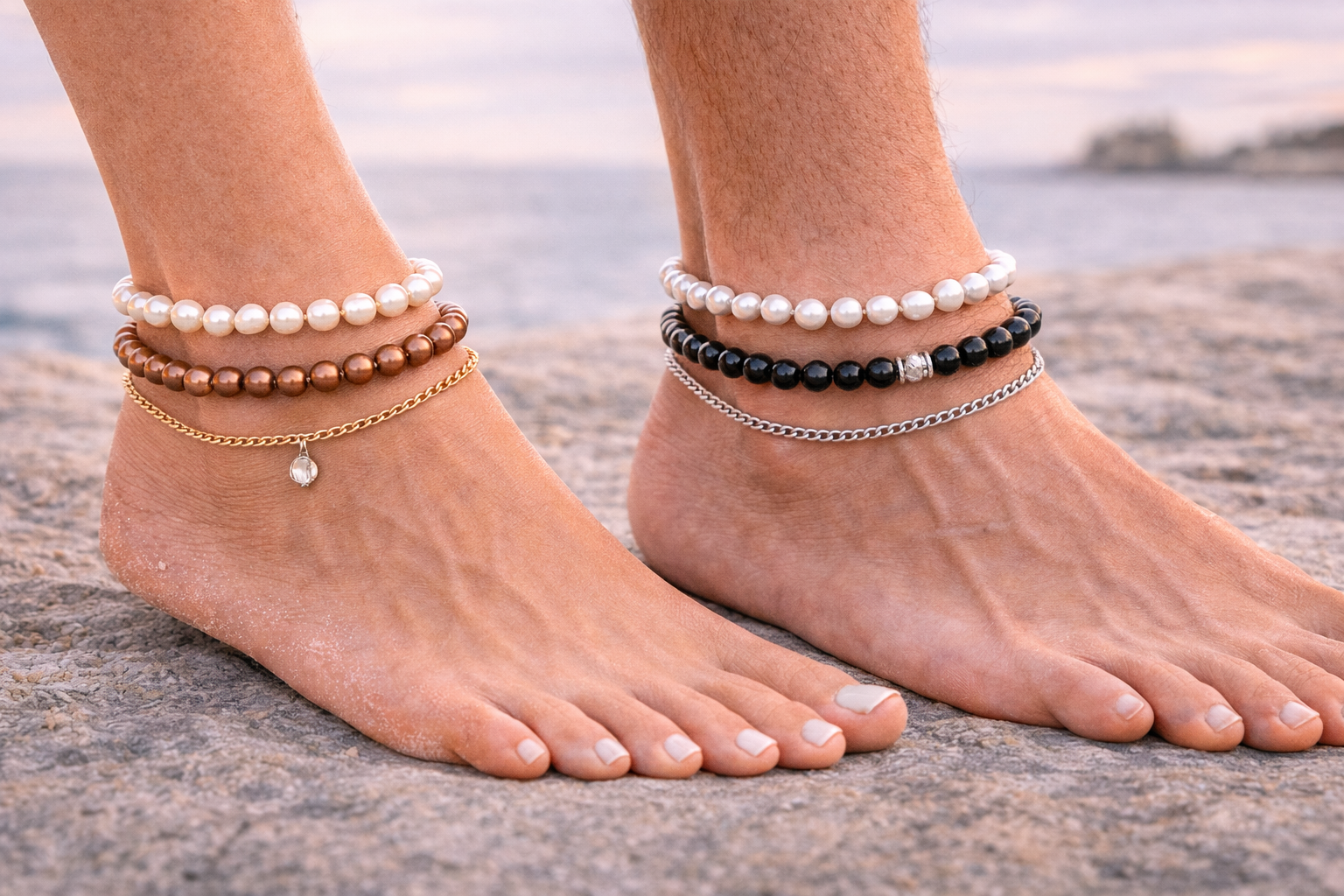

The pearl anklet has that quiet elegance that makes it seem like it can be worn with anything. In reality, the same design can go from refined to messy depending on the outfit it's paired with, the shoes it's worn with, and the ankle it rests on. This guide is entirely dedicated to a single question, the one that really matters when taking it out of the drawer: how to wear it so that it enhances the silhouette instead of getting lost in the background?
Here you will find concrete pairing rules, the shoes that highlight pearls, the times when they shine and those when they are best left at home, the most common style mistakes, and two or three pearl-specific care tips. We deliberately focus on wearing and styling: extensive material comparisons, the symbolism of stones, or detailed bohemian looks can be found on other pages that we will point out throughout the text.
Why pearls are worn differently from other ankle jewelry
Before talking about outfits and shoes, it's important to understand what makes pearls special on the ankle. Unlike a delicate steel or silver chain, which plays on the metal's shine and the link's movement, pearls rely on a soft, almost milky light. They don't illuminate the skin; they coat it. This detail changes everything: where a chain catches the eye with successive flashes, a pearl creates a continuous, calm line, evoking naturalness, the beach, and an effortless femininity.
This texture directly influences how it's worn. Pearls require natural light to reveal their nuances, they love tanned skin and fluid fabrics, and they don't tolerate being overloaded. A wrist covered in metal bracelets allows for accumulation; an ankle adorned with pearls does not. The jewelry works by breathing, not by showing off. This is precisely why it has a reputation for being "easy" when it is actually demanding: it does not tolerate approximation.
Nacre pearls, freshwater pearls, multi-strand pearls: three looks, three uses
Not all pearls are worn in the same way. The classic nacre pearl, round and regular, gives a clean and dressy look that pairs very well with a simple outfit it enhances. The freshwater pearl, more irregular and slightly baroque, emphasizes an artisanal and natural feel: it's the pearl for relaxed looks. Finally, multi-strand designs, which layer several thin strands of pearls, add volume and an immediate vacation vibe, ideal on bare skin in summer.
This variety of looks also determines the occasion. A single pearl on a discreet chain works for a day at the office without a fashion faux pas, while a colorful multi-strand clearly claims a summery and sunny aesthetic. If you're still undecided between different materials even before considering pearls, the question of choosing between pearls, shells, and chains deserves its own read: we've covered it separately in pearls, shells, or chains: which to choose, so as not to overload this guide dedicated to styling.

Elegant Pearl Ankle Chain
The pearl on a delicate chain: the versatile model that suits both the office and beach sandals.
29,90 EUR
View this model ->How to pair a pearl anklet with your outfit
The golden rule is simple: pearls love clothes that show off the ankle and let the leg breathe. Anything that exposes the lower leg works in their favor; anything that covers it neutralizes them. This is why this piece of jewelry is primarily worn in spring and summer, with fluid outfits, and becomes discreet or even invisible under straight jeans and ankle boots.
Outfits that enhance pearls
Flowing dresses, long slit skirts, linen shorts, wide slightly cropped pants, and short jumpsuits are ideal. In all these cases, the movement of the fabric accompanies that of the ankle, and the pearl appears intermittently, creating exactly the desired effect: a point of light that reveals itself without ever dominating. On slightly tanned skin, a white or ivory pearl stands out with remarkable clarity.
In terms of colors, pearls behave like a warm neutral. They go well with beige, off-white, faded blue, khaki, and natural prints. However, they are wary of highly saturated outfits and busy patterns, which make them look like a forgotten accessory rather than a chosen one. If your summer wardrobe leans towards raw materials, fringes, and layering, know that the bohemian spirit deserves a guide of its own: we detail complete outfits and inspirations in bohemian anklet: ideas and inspirations, rather than turning this page into a catalog of looks. This thread continues in Anklets in spring: how to reintroduce and wear them after winter.
Layering: pearls alone or accompanied?
Pearls can be worn with a second piece, provided it is more discreet than the pearl itself. A very thin gold chain placed above a string of pearls works, as the two operate in different registers. However, layering two pearl bracelets of similar sizes blurs the visual: the eye doesn't know where to focus. The logic is always the same: one piece leads, the other follows. A multi-strand piece is sufficient on its own: it's already an integrated layering, and doubling it would be too much.

Multi-Strand White Pearl Ankle Bracelet
The ready-to-wear multi-strand volume for summer: it adorns a bare ankle without needing a second piece of jewelry.
26,90 EUR
View this model ->Which pearl shade for your skin and outfit?
The color of the pearl completely changes the effect on the ankle, and it's a styling lever that is often underestimated. Pure white pearls create a sharp, almost graphic contrast on tanned skin: this is the shade that "pops" the most in summer. Ivory or cream pearls, warmer, blend more into the skin and give a soft, discreet look, ideal for daily wear that isn't meant to draw attention. Tinted pearls, powdered pink or gray, add a controlled touch of color that dialogues with the outfit rather than the skin.
The right approach is to match the pearl not to the dominant color of the outfit, but to its intensity. A light, mineral outfit calls for a white or ivory pearl that extends the palette; a bolder outfit can handle a pearl that contrasts slightly to create a point of breathing room. When in doubt, ivory remains the most versatile choice: it never misses the mark, regardless of the season.
What shoes to wear with a pearl anklet?
The principle is simple and directly stems from the nature of the jewelry: the pearl wants to be seen, so it calls for open shoes. Flat sandals, open-toed sandals, gladiator sandals, wedge espadrilles, dressy flip-flops, and of course bare feet on the sand place the pearl exactly where the eye falls. The ankle is exposed, the jewelry breathes, and the light does the rest.
With closed shoes, it's not forbidden but requires a method. Low-top sneakers worn with cropped or rolled-up pants reveal a portion of the ankle, which is enough to make a delicate model stand out. High-top boots, however, swallow the jewelry: in these cases, it's better to save the pearl for later in the day. The complete details of shoe pairings, season by season, go beyond the scope of this style guide; we have developed it in anklets and sandals: the right combinations, where each type of sandal finds its ideal jewelry.
| Shoe | Effect with pearls | Recommended model |
|---|---|---|
| Flat sandals / open-toed sandals | Ideal: ankle is completely bare | Multi-strand or single pearl |
| Wedge espadrilles | Very good: lengthens the leg, highlights the pearl | Pearl on a delicate chain |
| Low-top sneakers | Good with cropped pants | Delicate and fitted model |
| Ankle boots / high-top shoes | Avoid: the jewelry disappears | Save for an open outfit |
When to wear pearls on the ankle, and on which ankle
Pearls have a preferred season and rhythm. Understanding when to wear them avoids the "out-of-season summer jewelry" effect, which makes them seem out of place in the middle of winter under several layers of clothing.
The ideal moment: light, bare skin, light outfits
Pearls are at their best on vacation, by the sea, during summer strolls, late afternoon terraces, and beach outfits. Natural light reveals their nacre, bare skin provides a setting, and the relaxed atmosphere embraces their softness. It is this context, more than any rule, that justifies their presence on the ankle.
For everyday wear, they are still possible in a delicate and well-fitted design, provided you accept that they play a more discreet role. For those who hesitate to make pearls their everyday jewelry rather than a purely summery piece, the general arbitration between seasonal and daily use is covered separately in summer vs. daily anklet: here we remain at the level of the pearl itself.
Times when it's better not to wear them
Certain situations frankly do not suit pearls. Sports, prolonged swimming in the sea or pool, long days in the sand, and very active professional environments put the jewelry to the test and, often, hide it. In these cases, a more resistant metal chain does a better job. It's not a question of taste but of common sense: save the pearl for times when it can be seen and is not at risk.
On which ankle to wear your pearls?
The short answer: whichever ankle you prefer, the choice today is purely aesthetic. It's often worn on the ankle that is most visible depending on how one crosses their legs, or simply on the side you like. Old cultural interpretations, long attached to the right or left side, are worth knowing but no longer hold as rules: we explain them in detail in on which ankle to wear an anklet.

Minimalist Gold Anklet with White Pearls
The delicate and fitted model designed for discreet daily wear: subtle enough for the office, bright enough for summer.
26,90 EUR
View this model ->Style mistakes to avoid, pearl care, and the right model
Wearing a pearl anklet well comes down to a few simple habits. The most common mistakes are always the same, and they can be corrected in a minute once identified.
The most common style blunders
The first mistake is the size. A model that is too long will wrap around the ankle and hang to the side; one that is too tight will mark the skin and break the line. Pearls require a precise fit, with just enough slack to move without slipping. The second mistake is accumulation: too much jewelry in the same place drowns the pearl and makes it lose its nature as a focal point. The third is the wrong context, as mentioned before, wearing a pearl where it won't be seen. The fourth, finally, is neglecting maintenance, which quickly dulls the nacre.
Maintenance: two or three pearl-specific habits
Pearls are living, porous material, more fragile than metal, and require three specific precautions. First, avoid prolonged contact with salt water and chlorinated water, which attack the nacre: therefore, remove the jewelry before swimming in the sea or a pool. Second, limit friction, as the surface of pearls can scratch and dull with repeated contact from a bag, shoe, or other jewelry. Finally, keep pearls away from perfumes, sunscreens, and cosmetic products, which should always be applied before putting on the jewelry, never after.
These targeted actions are enough to preserve their luster daily. For the complete maintenance routine, valid for all types of ankle bracelets, from regular cleaning to storage and clasp inspection, refer to how to care for an ankle bracelet, rather than reiterating everything here.
Pearls and natural spirit: the nuance with stones
Pearls and natural stones are often confused because both evoke naturalness and softness. In terms of style, pearls offer a milky, dressed-up light, while stones provide color and raw material. These are two distinct aesthetics that are not worn in the same way. Everything related to meaning, virtues, or lithotherapy is another topic, which we cover entirely in natural stone ankle bracelets: here, we focus on the aesthetics and wearing of pearls.
And for men?
This guide is intended for feminine and unisex wear. The pearl ankle bracelet also comes in masculine versions, with more matte, darker pearls and simpler settings, but the wearing codes are different enough to warrant their own page. If this is what you're looking for, everything is covered in the men's pearl ankle bracelet.
Where to find the right pearl model
To choose with confidence, the easiest way is to start with the dedicated collection pearl ankle bracelets, which brings together mother-of-pearl finishes, multi-row designs, and fine chain models. To compare more broadly with other styles, the selection of all our ankle bracelets offers an overview, while the range women's ankle bracelets targets models designed for feminine wear. Finally, if you're looking for a more resistant piece to alternate with pearls for sports or swimming, take a look at ankle chains in metal.
This guide is part of our complete guide to ankle bracelets and ankle chains, where you will find all styles, materials, and wearing advice in one place.
Frequently asked questions about wearing a pearl ankle bracelet
Can you wear a pearl ankle bracelet with sneakers?
Yes, as long as your ankle is visible. Low-top sneakers paired with cropped or rolled-up pants work well with a delicate, fitted model. With high-top boots, the jewelry disappears: in that case, it's better to save it for a more open outfit.
Is a pearl ankle bracelet worn in winter?
It is primarily a fair-weather piece of jewelry, meant to be seen with bare skin and light. In winter, under several layers and closed shoes, it loses most of its appeal. You can keep it for indoor wear or a sunny getaway, but it's not its prime time.
Can you swim with a pearl ankle bracelet?
It's best to avoid it. Salt water and chlorinated water attack the nacre and dull the pearls over time. Remove it before swimming, and opt for a sturdy metal chain if you want to keep an ankle piece in the water.
Which ankle should it be worn on?
Whichever you prefer: the choice is now purely aesthetic, right or left. Old cultural interpretations no longer serve as a rule; we detail them in our article dedicated to the side of wear.
How to prevent pearls from tarnishing?
Apply perfume and sunscreen before putting on the jewelry, avoid salt and chlorinated water, and limit friction by storing it away from other pieces. These three habits are sufficient for daily care; the complete maintenance routine is detailed in our dedicated guide.
Pearl, shell, or chain: which to choose for a beginner?
It depends on the use and desired style. Pearls emphasize softness and summer elegance, shells an oceanside vibe, and chains offer shine and durability. We compare the three materials in detail in our dedicated article to help you decide.

