

Cart
0
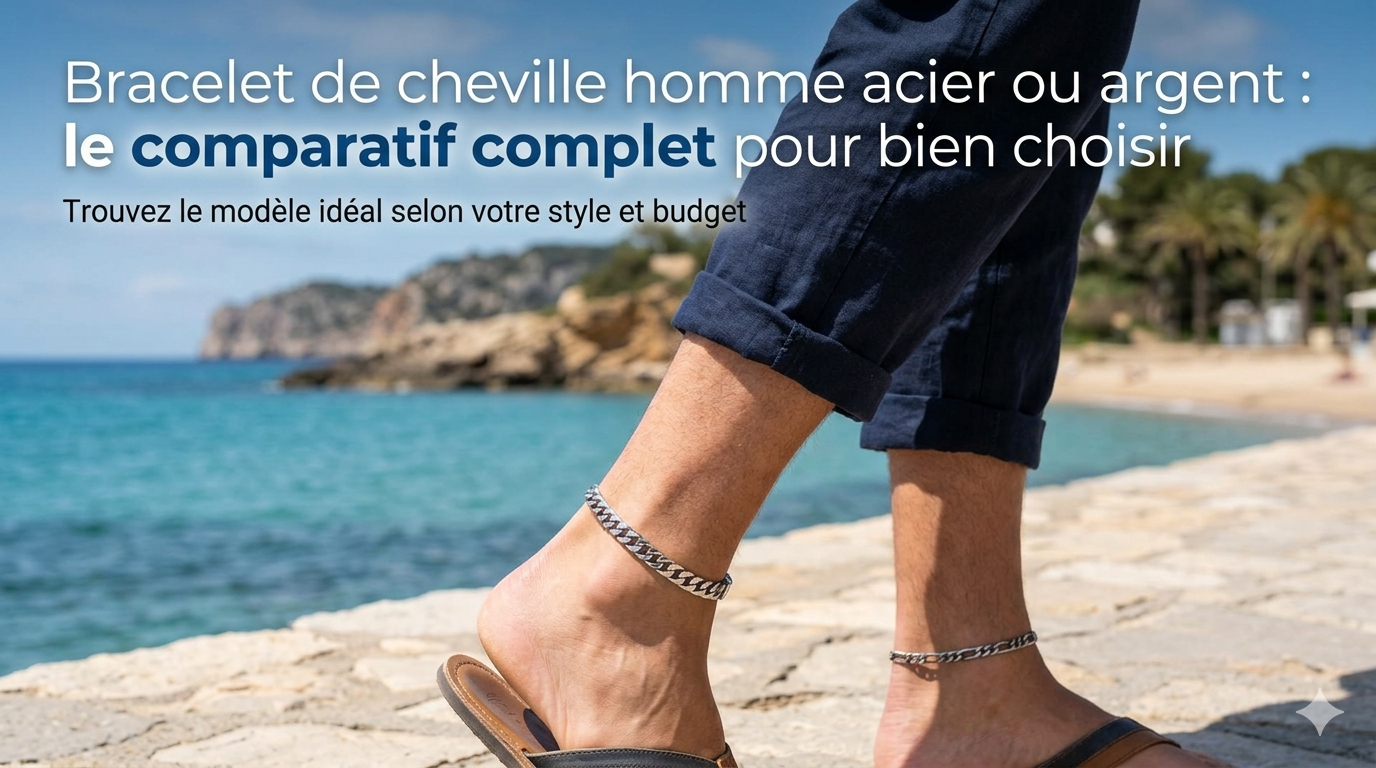
Men's Ankle Bracelet Steel or Silver: The Complete Comparison for Making the Right Choice
Once you've decided between cord and chain, a second question divides men when choosing an ankle bracelet: 316L stainless steel or 925 sterling silver? Both are metallic, both are noble, both are durable. But they tell different stories and behave differently in everyday life. One is modern pragmatism, indestructible and hypoallergenic. The other is classic nobility, which develops a patina and is passed down. This article scrutinizes both materials. Physical properties, visual rendering, ideal contexts, price, actual durability, maintenance. By the end, you'll know exactly which one matches your style, your daily life, and your relationship with jewelry. To delve deeper into this topic, also see Gifting an Ankle Bracelet to a Man: The Gift Guide to Avoid Mistakes. To delve deeper into this topic, also see Ankle Bracelets at Any Age: Can You Really Wear Them at 40, 50, and Beyond?.
EXPRESS VERDICT
316L Steel for pragmatism, maximum robustness, sports, swimming, sensitive skin, and a controlled budget. 925 Silver for timeless nobility, elegant patina, a lifetime signature piece, and a memorable gift. If you wear it daily and play sports: steel. If you want ONE piece of jewelry to keep for 15 years and that appreciates in value: silver.
Why the Steel vs. Silver Debate Exists
Visually, the two materials can look similar from a distance. Both display a white-silver luster, and both come in fine chains. The difference appears when you look closer and wear them over time. Steel has a colder, more metallic, almost industrial sheen. Silver has a warmer, more organic glow, which subtly changes with the light. Steel remains identical year after year. Silver develops a patina, darkens slightly in certain areas, and then regains its luster after cleaning. This difference in behavior explains why the choice is a dividing one.
For an overview of men's ankle bracelets, consult our complete guide to men's ankle bracelets.
316L Stainless Steel: Modern Pragmatism
316L stainless steel, also known as surgical steel, is an alloy of iron, chromium (16-18%), nickel (10-14% chelated, thus inactive), and molybdenum. This composition gives it three exceptional properties. Hypoallergenic due to the chelated nickel (which does not release upon contact with the skin, unlike ordinary steels). Indestructible (resistance to corrosion, oxidation, UV, impacts). Resistant to seawater and chlorinated water (you can swim, shower, sweat without any problem). To delve deeper into this topic, also see Ankle Bracelets and Pregnancy: Which to Wear, How to Adapt, and What to Avoid. To delve deeper into this topic, also see Ankle Bracelet that Stains Skin Black: Why it Happens and How to Permanently Prevent It.
Real everyday advantages. You can wear it for months without taking it off. No maintenance other than occasional cleaning with soapy water. No special storage. No risk of allergies even on reactive skin. No visible oxidation over time. Available in silver (most common), gold (PVD), or rose gold finish. The topic is covered in more detail in Titanium Ankle Bracelet: The Ultra-Light and 100% Hypoallergenic Metal Decrypted.
Honest disadvantages. The luster remains cold and a bit industrial. A patina never develops (the jewelry doesn't become more "you" over time). The residual resale value is zero. And even if the quality is excellent, steel is still perceived as a "modern pragmatic" material rather than "noble jewelry." Our complete guide on the stainless steel ankle bracelet details all its technical properties.

925 Sterling Silver: Classic Nobility
925 silver, or sterling silver, is an alloy of 92.5% pure silver and 7.5% copper (generally). This international standard guarantees a noble metal strong enough for jewelry, unlike pure 999 silver which is too soft. It has been the global standard for silver jewelry since the 13th century. Recognizable by the "925" hallmark stamped on the piece.
Real everyday advantages. Warm and natural white-silver luster, which captures light more subtly than steel. Hypoallergenic for the vast majority of skin types. Noble metal that develops a patina over time: slight oxidation creates a dark patina in recesses that highlights details and adds character. Infinitely recyclable. Significant resale value (10-15% of the purchase price depending on condition). Jewelry that can be passed down.
Honest disadvantages. 925 silver tarnishes over time due to contact with air and ambient sulfur. This is not a defect, but a characteristic of the material, requiring occasional cleaning (5-10 minutes with baking soda every 2-3 months). Avoid prolonged chlorinated water (pool) and intensive saltwater (patina can become too dark). More delicate with violent impacts (possible scratches). Higher initial price than steel.
To compare 925 silver and gold finish, also read our article classic or gold-plated 925 silver, which to choose.

Detailed Comparative Table (12 Criteria)
↔ Scroll table on mobile
TO REMEMBER
Out of 12 criteria, none is absolutely decisive. Your lifestyle should decide, not the material. Ask yourself this question: "Do I want jewelry that requires no effort (steel) or jewelry that becomes more 'me' over time (silver)?"
Steel is particularly suitable for...
- ✓ The athletic man (swimming, fitness, running, intense sweating)
- ✓ The man who lives near the sea or in a hot, humid region
- ✓ The man with metal-sensitive skin
- ✓ The man who wants a "set-and-forget", low-maintenance piece of jewelry
- ✓ The frequent traveler (luggage, varied climates, hotel showers)
- ✓ Controlled budget (≤ €40)
Sterling silver is particularly suitable for...
- ✓ Men who appreciate noble jewelry (collection, heirloom)
- ✓ Executives, businessmen, suited men: more elegant shine
- ✓ Men who like their jewelry to "age with them" (patina)
- ✓ A memorable gift (birthday, wedding, life milestone)
- ✓ Men who invest in long-term material quality
- ✓ Urban wearers who don't expose their jewelry to extreme conditions
How much to spend for each material
316L Steel (€25-€60)
€25-€35: decent entry-level. Standard 316L steel, 2-3 mm chain, simple matte or shiny finish. Lasts 10 years with intensive daily wear. €35-€45: mid-range. Premium 316L steel with worked links (Figaro, Venetian, Marine), solid clasp, neat finishes. The sweet spot for men. €45-€60: high-end steel. 316L steel with gold or rose PVD finish, integrated pendant, signature design. A true piece of jewelry in steel.
Sterling Silver (€40-€150)
€40-€60: decent entry-level sterling silver. Thin chain, standard finish, solid clasp. The sweet spot to start with silver. €60-€90: worked sterling silver with specific links, optional pendant, premium matte or shiny finish. Lasts 15-20 years. €90-€150: high-end sterling silver, rare links, customizable pendant, artisanal finish. A piece of jewelry to be passed down. €150 and up: unique artisan pieces, jeweler's signature, custom-made.
EXPERT ADVICE
For a first men's purchase, go for 316L steel at €30-€40. No major emotional or financial commitment. If you love it and wear it every day for 6 months, you'll then know if you want to upgrade to sterling silver.
Recommended thickness for each material
Steel handles thicker gauges better: 2 to 4 mm without issue, the metal remains visually solid. Sterling silver prefers thin to moderate thicknesses: 1 to 3 mm to remain elegant. Beyond 3.5 mm in silver, the jewelry appears heavy and loses its charm. To delve deeper into this, read our article what chain thickness to choose for an anklet.
And the compromise: 316L steel with a silver finish?
Are there models that combine both? Yes, and it's an interesting third option. 316L steel can be PVD (Physical Vapor Deposition) treated to achieve a finish that visually mimics sterling silver, while retaining the mechanical properties of steel. You get the warmer shine of silver + the robustness of steel. Limitation: the PVD finish can fade after 2-3 years of intensive wear (no oxidation, just a duller shine). A good option for those who are truly undecided between the two.

Choose according to your male profile
Intensive athlete
→ 316L Steel. Sweat, water, friction, shock: it handles it all. No risk.
Business executive
→ Sterling Silver. Elegant shine, noble perception, suitable professional code.
First purchase
→ 316L Steel at €30-€40. Test without major commitment.
Long-term signature jewelry
→ Sterling Silver at €60-€100. A piece to keep for 15-20 years, transmissible.
Memorable gift
→ Sterling Silver. Strong perceived value, noble dimension of giving.
Traveler / nomad
→ 316L Steel. Luggage, varied climates, seawater, hotels: indestructible.
Compared Maintenance
316L Steel Maintenance
Almost none. Occasional cleaning (once a month) with warm soapy water + a soft cloth is sufficient. For stubborn dirt, a soft toothbrush. 316L steel never oxidizes, doesn't tarnish, doesn't change over time. No special storage (normal box is OK). You can wear it for 6 months without intervention.
Sterling Silver Maintenance
Light but regular. Silver naturally tarnishes in contact with air and sulfur. Every 2-3 months, give it a baking soda bath: 1 tablespoon of baking soda in 250 ml of hot water, soak your bracelet for 5-10 minutes, gently brush with a soft toothbrush, rinse with clear water, dry with a microfiber cloth. The shine returns 100% in 10 minutes. Ideally store in an anti-tarnish pouch (sold for €5-€10 in jewelry stores).
For the complete maintenance guide for all materials, read how to care for an anklet.
FAQ Steel vs Silver
Is steel really hypoallergenic?
316L steel (surgical grade) is hypoallergenic for 99% of wearers. The nickel it contains is chelated (chemically bonded) so it does not leach. For the 1% who are hypersensitive, sterling silver is safer. But for the vast majority, 316L steel = no risk.
Will sterling silver really tarnish?
Yes, but slowly. 3 to 6 months for patina to appear, depending on your perspiration, ambient air (presence of sulfur), and exposure to the climate. This tarnishing is superficial and can be cleaned in 10 minutes with baking soda. It's even a sign of quality: fake silver never tarnishes.
Which one looks better on a man?
Visually, both look the same. But sterling silver has a warmer, more organic shine, which pairs better with tanned skin tones or light clothing. 316L steel has a colder, more industrial shine, which suits urban and streetwear styles better. From a distance, both are indistinguishable.
Can you wear steel AND silver at the same time?
Visually, yes, they both look like silver. But it's a loss of logic: why mix? It's more consistent to choose one material and stick with it. Unless you wear a steel piece on your wrist (resistance) and a silver one on your ankle (elegance): that can make contextual sense.
Which material for a men's gift?
If you want a "noble" gift (30th birthday, wedding, major event): sterling silver, budget €60-€100. If you want a "discovery" gift (first try, Father's Day, Christmas): 316L steel, budget €30-€50. Both are decent gifts; it's the message that changes. To read further: Anklet to give as a gift: the right model and budget according to the occasion of the year.
Which one for daily swimming?
316L steel exclusively. Sterling silver tolerates occasional fresh water but not daily swimming in chlorinated pools (chlorine accelerates tarnishing). In seawater too, steel remains unbeatable. If you swim every day: no hesitation, steel.
Which material will have the best value in 10 years?
Sterling silver, without a doubt. It's a noble metal whose price historically increases (between 5 and 10% per year on average over 30 years). 316L steel has no resale value. So if you buy a sterling silver bracelet for €80 today, it will probably be worth €100-€120 in 10 years. Steel at €30 will still be worth €5.
The final word
Steel or silver, there's no wrong choice. There's just a choice that's consistent with your lifestyle and your relationship with jewelry. If you want absolute simplicity, indestructible pragmatism, maximum value for money: 316L steel. If you want classic nobility, a patina that develops with time, a piece of jewelry to be passed down: sterling silver. And if you're undecided, start with a 316L steel at €30-€40, and invest in sterling silver in 6-12 months when you've confirmed that anklets are part of your daily life.
To explore the full selection, browse our men's anklet collection, our stainless steel collection for durable models, and our silver anklets for classic nobility.
TO GO FURTHER
This article is part of our complete guide to men's anklets. For the full overview, see our ultimate guide to anklets.
Also discover our 4 thematic guides: choosing · women · men · meaning.

