

Cart
0
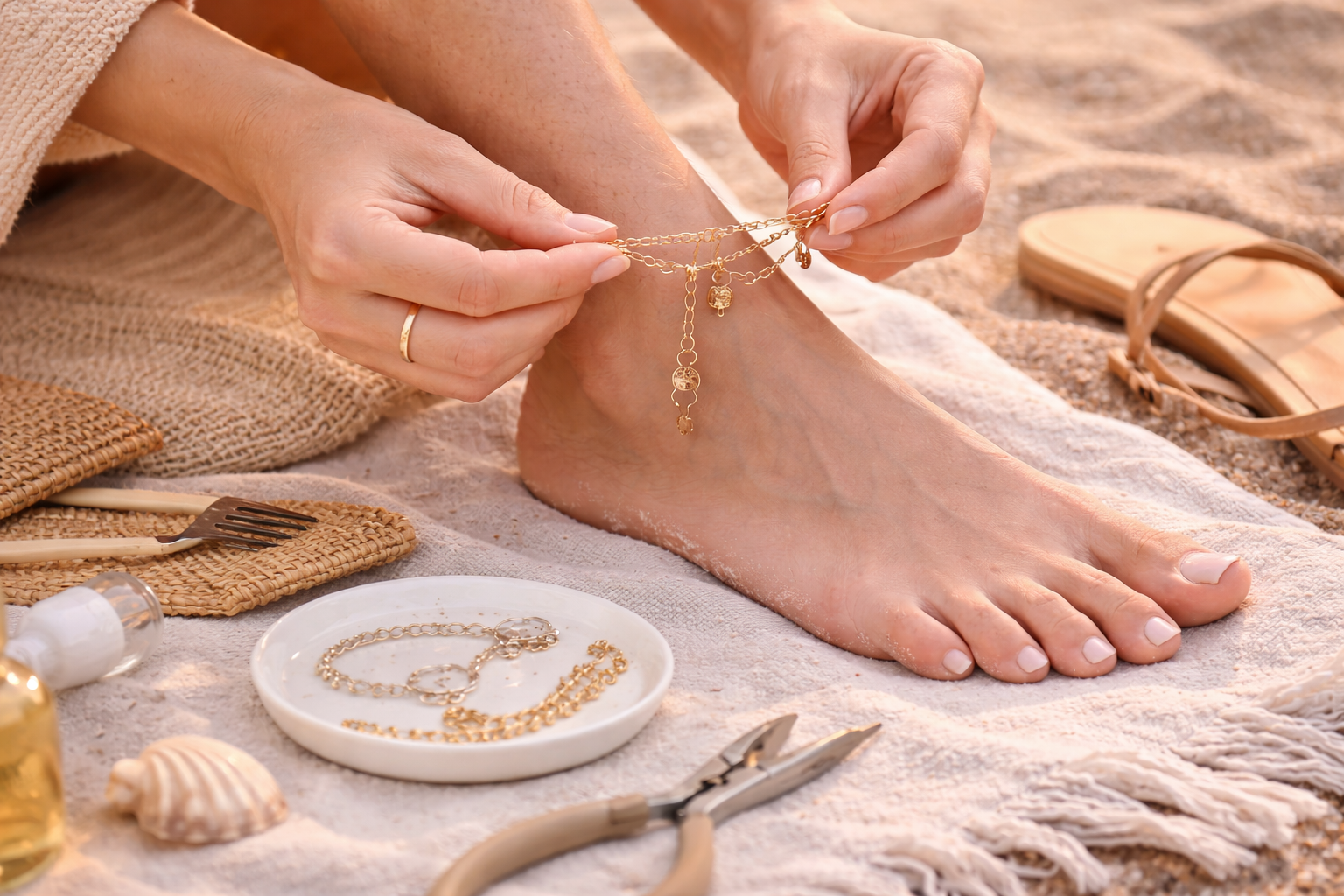
Why does an ankle bracelet get tangled?
A tangled ankle bracelet is a common problem, especially with thin chains or multi-strand designs.
Knots generally appear due to:
- repeated ankle movements
- friction with shoes or pants
- very thin and highly mobile chains
- overlapping multiple strands
This phenomenon mainly concerns thin chains, such as those available in Ankle Chains .
Understanding the cause is essential to applying the right solution. These principles are part of the overall logic explained in the complete guide to ankle bracelets and chains .
The most affected models
Not all bracelets tangle in the same way.
The most susceptible are:
- very thin chains (1–2 mm)
- multi-strand bracelets
- models with light pendants
- very long and loosely fitting chains
If your bracelet regularly gets tangled, it may be related to its thickness, as explained in What chain thickness to choose for an ankle bracelet? .
Good news: there are simple solutions to avoid this problem daily.
How to untangle an ankle bracelet without damaging it?
When a chain gets tangled, the natural reflex is often to pull on it. Bad idea: you risk creating a tighter knot or damaging the clasp and links.
First and foremost, remember a simple rule: the slower you go, the faster it untangles. This logic of care and maintenance aligns with the advice in How to care for an ankle bracelet? Simple tips to keep it like new and is part of the complete guide to ankle bracelets & chains .
Method 1: the "flat surface" technique
This is the most effective and safest method.
- Place the bracelet on a table (hard, flat surface).
- Gently separate the tight areas.
- With your fingers, find the point where the knot is most "flexible."
- Untangle little by little, without pulling on the ends.

👉 Tip: if the bracelet is very thin (delicate chain), this method is ideal on a well-lit table.
Method 2: needle/pin (for tight knots)
If the knot is compact, use a thin needle or pin:
- Lay the bracelet flat.
- Gently insert the tip into the knot.
- Make small movements to "open" the knot.
- Alternate with your fingers to release tension.
⚠️ Never force it: if you damage a link, the chain weakens and tangles even more easily.
Method 3: "talc" (if the chain is sticky)
If the bracelet has been worn in summer, sweat or sunscreen residue can make the chain slightly sticky. In this case:
- Lightly sprinkle with talcum powder (or flour as a makeshift).
- Gently massage the knot.
- Resume the flat surface method.
Mistakes to absolutely avoid
- pulling hard on both ends
- shaking the chain to "loosen" the knot
- using pliers (risk of marking the metal)
- forcing near the clasp (fragile area)
If your bracelet often gets tangled, the cause may be the thickness or length, discussed in What chain thickness to choose?
Preventing an ankle bracelet from tangling: simple solutions
The best "untangling" is the one you never have to do. If your bracelet often gets tangled, the solution isn't just technical: it's also about choosing the right model and how you wear it.
1) Adjusting the length: the #1 factor
A bracelet that is too long moves more. The more it moves, the more likely it is to twist, cross links, and create a knot.
👉 Solution: choose a well-fitted length (slightly "loose," but not floating).
2) Choose the right chain thickness
Very thin chains are more mobile and tangle more easily. A slight increase in thickness (without being "chunky") often stabilizes the jewelry.
👉 Solution: aim for a balanced chain rather than an extremely thin one.
3) Be careful with multi-strand bracelets: the risk increases
Multi-strand bracelets are naturally more prone to knots. The strands cross, twist, then lock.
👉 Solutions:
- prefer a well-"structured" multi-strand bracelet
- avoid overly long strands
- limit mobile pendants
To wear it hassle-free, see Multi-strand ankle bracelet: how to combine it? .
4) Limit overly mobile pendants
Light charms can "catch" the chain, slip into a link, and form the beginning of a knot.
👉 Solution: opt for a discreet detail, or a bracelet without a pendant if you move a lot daily.
5) Material can help (or worsen)
Some materials hold their shape better and resist twisting. Stainless steel, for example, is often more stable and durable for everyday wear.
👉 For regular use, explore Stainless Steel Ankle Bracelets or a selection of chains in Ankle Chains .
If you want to compare materials, consult Ankle bracelet materials: complete guide .
6) Wear the right style for your use
If your bracelet regularly gets tangled, it might simply not be suitable for your use (daily vs. summer vs. event).
Anti-knot tips: how to store and wear your bracelet correctly
Even the best bracelet can get tangled if not used correctly. Fortunately, a few simple habits can prevent 90% of problems.
1) Always close it before storing
Leaving an open chain in a box is the main cause of knots.
👉 Always close the clasp before putting it down or storing it.
2) Avoid piles of jewelry
Never mix several bracelets in the same small box.
👉 Ideally:
- one compartment per piece of jewelry
- or an individual pouch
- or hung on a jewelry stand

3) Remove it before certain activities
Sports, the beach, or intense movements promote repeated twisting.
To know when to remove it, consult: Ankle bracelet and sport: compatible or to avoid? and Can you swim with an ankle bracelet? .
4) Choose a model suitable for your use
If your bracelet regularly gets tangled, it might simply be too thin for your daily life.
For frequent use, prefer stable models such as those available in:
Quick anti-knot checklist
- ✔️ Well-adjusted length
- ✔️ Thickness suitable for your use
- ✔️ Clasp always closed when storing
- ✔️ No mixing in the jewelry box
- ✔️ Regular maintenance
Conclusion: a well-chosen bracelet almost never tangles
An ankle bracelet that tangles is not inevitable. In most cases, the problem comes from:
- length
- thickness
- type of mesh
- storage
By choosing a suitable model and adopting a few simple habits, your bracelet will remain fluid, elegant, and knot-free.
To discover models designed for comfortable and durable use, explore Women's Ankle Bracelets or Men's Ankle Bracelets , and find all the detailed advice in the complete guide to ankle bracelets & chains .
To go further
→ Your bracelet is too loose? The method to adjust it yourself
ON THE SAME TOPIC
See also: choose an adjustable ankle bracelet.
TO LEARN MORE
This article is part of our complete ankle bracelet buying guide. For the complete overview, see our ultimate ankle bracelet guide.
Also discover our 4 thematic guides: choosing · women · men · meaning.

