

Cart
0
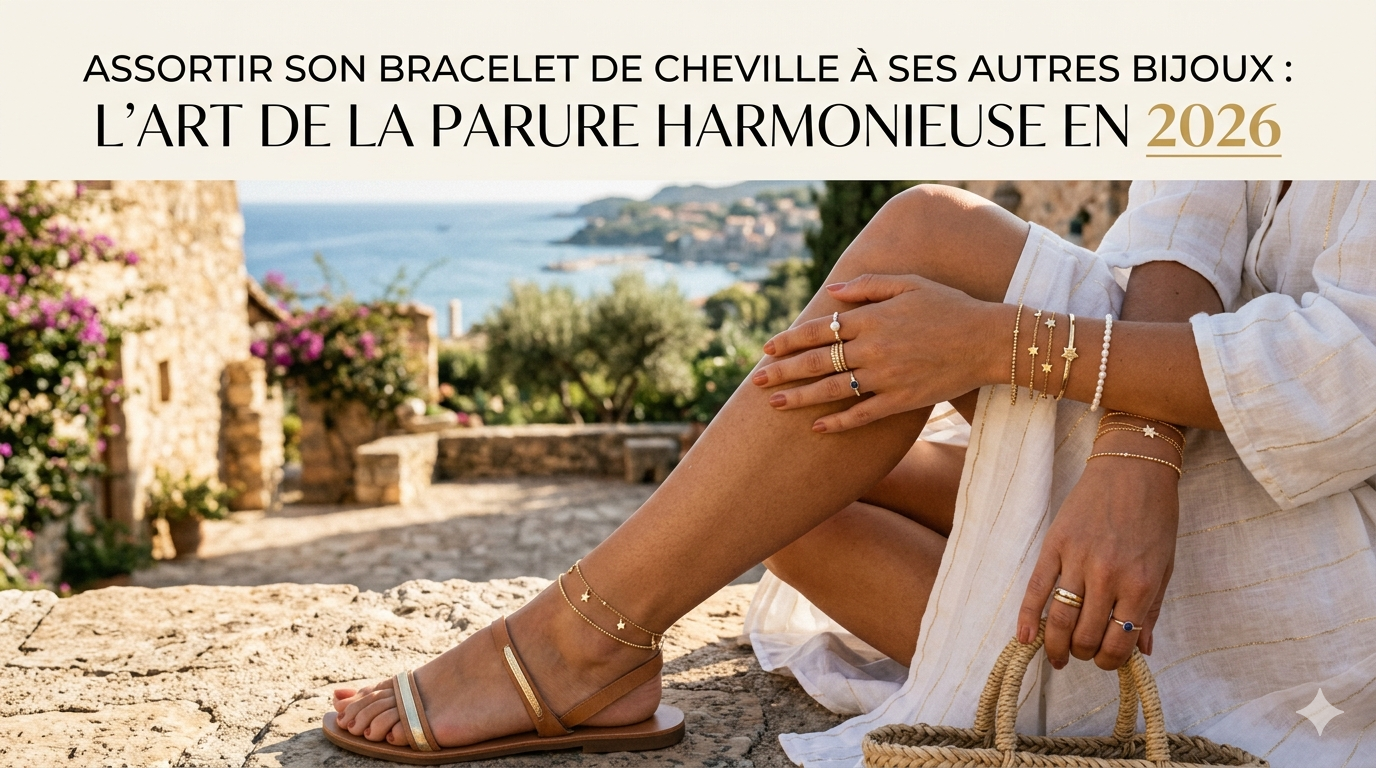
You've found the perfect anklet. It fits just right, catches the light when you walk, it's so you. And yet, some days, something feels off. It catches the eye, but the overall look doesn't sing. The culprit is rarely the anklet itself: it's the dialogue it has—or doesn't have—with the rest of your jewelry. A yellow gold ring on your finger, a silver bracelet on your wrist, mismatched hoop earrings, and suddenly the silhouette is fragmented. Matching your anklet to your other jewelry isn't a stylist's whim: it's what transforms an accumulation of accessories into a true, cohesive, and legible set.
Good news: this harmony requires neither an unlimited budget nor a professional eye. It relies on a few simple principles that you can master in an afternoon in front of the mirror. In this guide, we'll see how to choose a common thread, how to coordinate your anklet with foot, wrist, and neck jewelry, how to dare to mix gold and silver without a fashion faux pas, and how to adapt it all to your style and occasions. The goal: for each piece to serve the whole, and for your ankle to remain the detail that brings a smile, never the one that clashes.
✨ Why Coherence Changes Everything
An isolated piece of jewelry is judged on its own merits. A set, however, is judged on its relationships. It's just like an outfit: a magnificent sweater can look dull with the wrong pants, and with the right ones, it suddenly becomes elegant. Your jewelry works as a network. When the anklet, ring, bracelet, and necklace share the same logic—a metal, a fineness, a mood—the eye no longer has to arbitrate between contradictory signals. It reads an intention. And it's this perceived intention that gives the impression of a woman who knows what she's doing.
Conversely, an unassumed mismatch is the primary cause of that "almost good" feeling. Three different metals, a chunky piece on the ankle and delicate jewelry on the wrist, a bohemian style below and minimalist above: each element may be pretty, but together they contradict each other. Even before thinking about choosing a new model—a topic we cover in detail in our guide on how to choose the perfect anklet according to your style and lifestyle—you need to look at what you already wear. A jewelry set is built around existing pieces, not against them.
🔗 The Dominant Metal Rule
If there's only one thing to remember, it's this: choose a dominant metal and make it your guiding thread. This is the simplest and most effective rule for instantly giving coherence to a jewelry set. Yellow gold, rose gold, silver, gold-plated steel: it doesn't matter which one, as long as one shade leads the dance and the others remain discreet accents, or are absent entirely.
Concretely, if you wear a lot of silver daily—wedding band, steel watch, small hoop earrings—your anklet will benefit from staying within this cool-toned family. The inverse is true for devotees of gold, which warms tanned skin and brightens summer complexions. The gold versus silver question deserves closer attention: we've addressed it in our comparison on 925 silver anklets, classic or gold-plated, and the reflex to keep in mind is to start with what you already wear on your wrist and hands rather than thinking piece by piece.
Metal is not the only agreement variable, but it's the most visible. This is also why choosing a single shade then allows you to boldly mix varied materials without breaking the harmony. A very minimalist silver anklet can coexist perfectly with a bracelet of clear beads, as long as the metallic thread remains consistent. For someone who embraces silver, a piece like this provides a clean base from which everything else can flow.

ANKLET JEWELRY — The Silver Thread
Chic Silver Anklet
€39.90
The perfect base for a cool-toned set: its understated brilliance effortlessly matches your silver rings and bracelets, and allows the rest of the silhouette to breathe.
Discover →🦶 Coordinating with Foot Jewelry
The ankle doesn't exist alone at the bottom of the leg. Toe rings, foot chains, layered delicate bracelets: this entire ecosystem is seen at a glance when you wear sandals or walk barefoot on the sand. This is precisely the area where harmony is most visible, because the skin is bare and nothing distracts the eye.
The principle remains the same as elsewhere: coordinate first by metal, then by style. A gold foot chain beautifully extends a delicate gold anklet, creating a continuous line from ankle to toes. This idea of visual continuity is also what makes the stacking of anklets so successful: multiple pieces that complement each other are better than a single isolated one, provided they share a common denominator. Think "jewelry family" rather than "pieces side by side."
However, be careful not to overdo it. The lower leg already attracts attention; saturating it with competing pieces produces the opposite effect of the desired elegance. A delicate foot chain, a matching anklet, and, possibly, a thin toe ring in the same tone are more than enough. If you like abundance, at least maintain consistency in shade: that's what prevents accumulation from turning into clutter.

ANKLET JEWELRY — The Golden Line
Soléa Anklet – Gold Foot Chain
€34.90
A continuous line from ankle to toe, ideal for extending a golden set on bare summer feet and asserting a bohemian look.
Discover →💍 Echoing Upper Body Jewelry
A successful jewelry set creates echoes between the lower and upper body. The anklet should not be a free electron: it benefits from resonating with what is worn on the wrists, fingers, and neck. This dialogue plays out on three levels: metal, already mentioned, but also the fineness of the line and the vocabulary of motifs.
Fineness as a Common Thread
A very delicate ankle chain calls for equally delicate wrist jewelry. A chunky bangle on the wrist and a delicate chain on the ankle create a scale mismatch that unbalances the silhouette. Conversely, if you like bold pieces, embrace it everywhere: a slightly more substantial anklet will better dialogue with large rings and a structured bracelet. The question of thickness is not trivial, and we explored it in our article on what chain thickness to choose for an anklet: it affects comfort as much as visual harmony with the rest of the set.
Responding Motifs
Don't forget the neck and ears either, even if they are visually distant from the ankle. In a full-body photo or a full-length mirror, the eye scans the whole in a fraction of a second and immediately perceives whether the necklace and earrings belong to the same family as the anklet. A delicate gold long necklace, light hoop earrings, and an anklet in the same tone create a jewelry set that holds together from head to toe, without any piece needing to be imposing. It is often this subtle echo from top to bottom that makes people say "she's always well-matched" without knowing exactly why.
The third, more subtle level of agreement lies in motifs. A heart pendant on the ankle finds a nice echo in a ring adorned with a small heart or a charm necklace. The same reasoning applies to charms and symbols: if you like meaningful jewelry, it's better to make them dialogue rather than multiply them randomly. Our guide on the anklet with a pendant and choosing the right charm details how to select a symbol consistent with the rest of your pieces. As for multi-layered models, which add volume without changing registers, our article on the multi-layered anklet and how to style it shows how to integrate them without weighing down the overall look. You can also explore the entire women's anklet collection to identify pieces whose visual vocabulary matches that of your favorite jewelry. To delve deeper into this topic, also see Ankle or wrist: where to wear your bracelet, and can you wear both?.
Style tip
Before buying a new piece, photograph your most-worn jewelry side by side. You'll immediately see which shade dominates and which fineness appears most often: that's your specification. Any piece that naturally integrates will enrich your anklet collection without ever clashing.
🌗 Daring to Mix Gold and Silver
The dominant metal rule is not a prison. The deliberate mixing of gold and silver—the famous two-tone—has become one of the most modern signatures of contemporary jewelry. The nuance lies in one word: deliberate. A successful mix is recognized by its apparent logic, whereas an unintentional mix looks like an incomplete set.
The safest method is to introduce the second metal with repeated small touches rather than just once. If your anklet already blends gold and silver in its construction, it becomes a natural link between your gold jewelry above and your silver jewelry below—or vice versa. You can also choose a two-tone piece in a strategic spot to then allow everything else. The trick works even better if the hinge piece remains delicate: a thin and luminous model, like this double silver chain enhanced with rhinestones, plays this connecting role without ever being flashy. To delve deeper into this topic, also see Anklet with a skirt: how to style it according to length and style (midi, mini, pleated, long) in 2026.

ANKLET JEWELRY — The Hinge Piece
Women's Double Thin Chain Anklet with Brilliant Rhinestones in 925 Silver
€29.90
Its delicate double chain and rhinestone accents make it the perfect connecting element for a jewelry set: delicate enough to be understated, brilliant enough to link your other jewelry together.
Discover →One final limit keeps everyone from a fashion faux pas: a maximum of two metals. The two-tone works because it remains legible; add a third tone and the logic becomes blurred, the eye no longer knows what the common thread is. Gold and silver, period. The rest—pearls, stones, cords—are not counted as metals and can freely color the whole, provided they remain within the same mood range.
🎭 Adapting the Jewelry Set to Your Style
Everything above forms a grammar, not a dictatorship. How you apply it depends on your personal style, and that's where a jewelry set stops being a recipe and becomes a signature. A minimalist and a bohemian don't coordinate their jewelry in the same way, and that's a good thing.
The minimalist plays on scarcity and repetition: a single metal hue, clean lines, two or three pieces at most, chosen for their obviousness. If this is your world, the spirit of our article on the minimalist anklet and the look it serves will speak to you: here, coherence is born from simplicity. The bohemian, on the other hand, embraces profusion and the mixing of materials — beads, shells, braided cords — but almost always maintains a common chromatic thread, earthy tones, warm gold, or natural hues. Our guide on the boho anklet and its inspirations shows how this freedom remains, in reality, very codified.
Between the two, most of us navigate according to the days and occasions. An office set will be sober and cool, while a holiday set can allow for gold, beads, and a foot chain. The important thing is not to fix on a single style, but to maintain, in each configuration, a clear common thread. It is this reflex — choosing a common denominator before adding — that distinguishes a stylish woman from a simply well-accessorized woman. To delve deeper into the codes of warm metal, our article on how to wear a gold anklet without overdoing it usefully complements this reflection, and the anklet chain collection offers a good starting point for building a coherent line.
🪞 In summary: three reflexes to keep in mind
Matching your anklet to your other jewelry ultimately comes down to three simple actions. First, choose a dominant metal and stick to it: this is the common thread that instantly creates coherence. Second, create echoes — of fineness, pattern, hue — between the lower and upper body, so that the ankle responds to the wrist and neck rather than standing alone. Finally, dare to mix gold and silver only deliberately and clearly, with a maximum of two metals, relying on a pivotal piece that acts as a link. This thread is explored in Foot chain: the jewelry that connects the ankle to the toes (history, styles, and adjustment).
The rest is a matter of practice and pleasure. A set doesn't need to be expensive to be harmonious; it needs to be conceived as a whole. If you're starting your collection or want to streamline it, our complete guide to anklets and ankle chains gathers everything you need to know to choose well, from material to size. And to find the piece that will complete your set in the right tone, the complete selection of anklets awaits you. Once you've found your common thread, you'll never go back to "almost good."

