

Cart
0
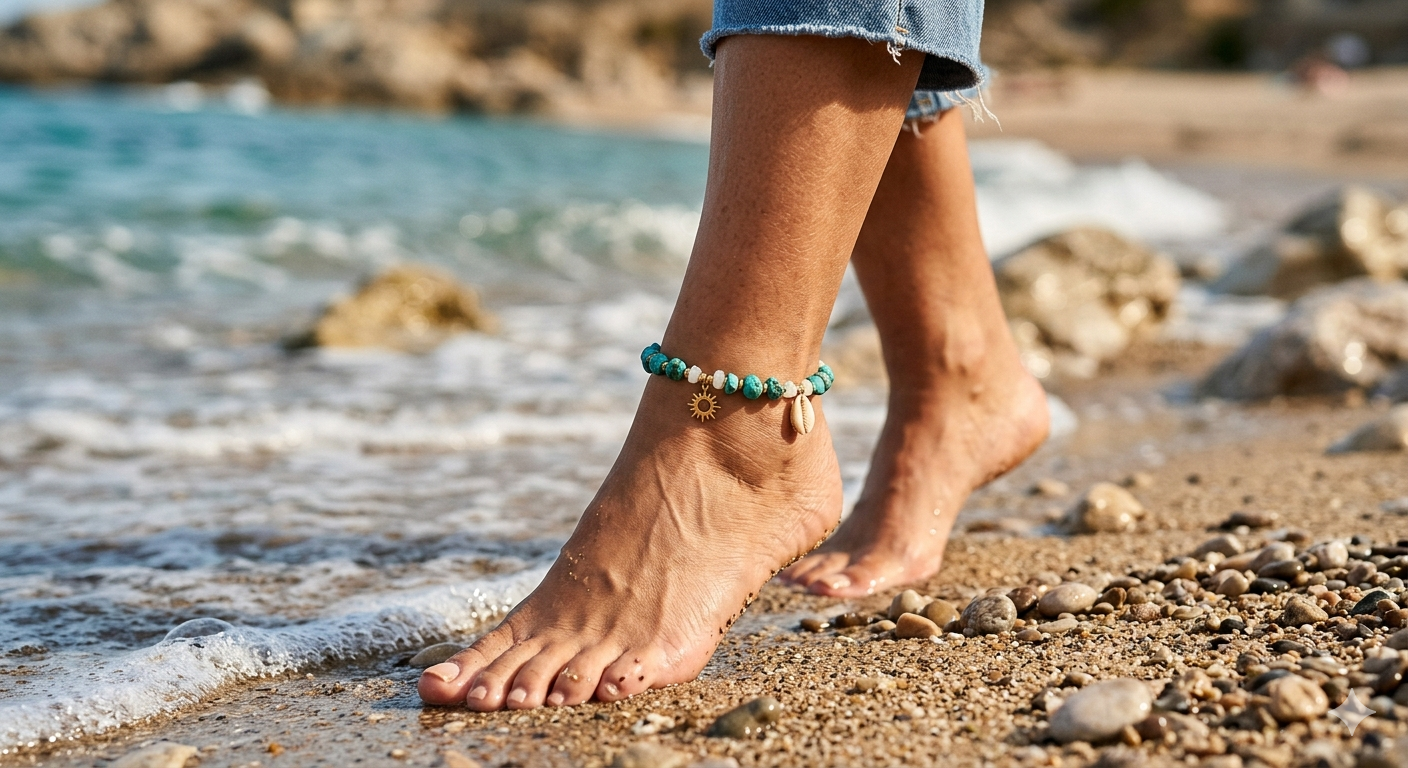
Amethyst, turquoise, tiger's eye, hematite... Natural stones are not just beautiful. They tell a story, carry an intention, and transform a simple anklet into a true skin talisman. Here's how to choose them, what they mean, and how to wear them without ever falling into folklore.
For a few seasons now, natural stone anklets have been making a strong comeback. We see them on the beaches of Biarritz, on Parisian terraces, in summer photos on Instagram. The phenomenon is not new. It's even very old. But it responds to a current demand: that of a piece of jewelry that has meaning, that can be worn every day, and that remains discreet under a dress as well as under jeans.
This guide will help you understand what each stone expresses, how to recognize them, how to combine them, and how to make them a signature element of your style. All without esoteric jargon, and without sacrificing fashion.
Why natural stones are so fascinating on the ankle
The anklet has always been a skin jewel. A piece of jewelry that is seen in movement, that accompanies walking, dancing, breathing. Adding a natural stone to this area of the body is extending a very old tradition. In India, women already wore ankle bracelets adorned with stones to protect themselves and show their status. In ancient Egypt, agate and turquoise beads were found on ankles. In the Mediterranean, coral and carnelian were slipped into braided threads as small guardians. To go further on this topic, see also Woven men's anklet: the guide to choosing an authentic masculine model in 2026. To go further on this topic, see also Rhinestone and zircon anklet: the complete guide to the sparkling ankle jewel in 2026.
Today, the symbolism has evolved, but the gesture remains the same. We choose a stone because we like its color, because it reminds us of a place, because it carries a personal intention. This is what makes this type of jewelry particularly endearing. You're not just wearing a material. You're wearing a story.
The other reason for this return is the fatigue of 100% synthetic jewelry. Gold chains have their charm, but the skin needs, from time to time, something that really comes from the earth. A polished stone always has a grain, a texture, a nuance that no steel can imitate. And on the ankle, where the light changes depending on the tan, shoes, and season, this mineral effect is immediately noticeable.
If you want to understand why this piece of jewelry is making such a comeback, the complete analysis is in our dedicated article on why the anklet is trending again in 2026. Natural stones are one of its strongest drivers.
The main stones used and what they mean
Each stone has an identity. It can be approached in two ways. The first, aesthetic: the color, the effect on the skin, the association with your wardrobe. The second, symbolic: the traditional meaning, often derived from lithotherapy or ancient uses. Both interpretations can coexist, and most women who wear these stones actually like this mix. No need to believe in it 100%. It's enough to appreciate the nod.
Amethyst, the stone of appeasement
Deep purple, sometimes light lavender. Amethyst is often associated with mental calm, sleep, and perspective. On an ankle, it gives a rather sophisticated, almost retro touch. It looks great on light skin with a small silver chain. On darker skin, it benefits from being combined with a gold chain to balance the coolness of the purple.

Turquoise, the stone of travel
Sky blue leaning towards green. Turquoise is the most identifiable stone for a summer anklet. It evokes the sea, holidays, the wind. Traditionally, it is considered protective, especially for those who travel. It is probably the most used stone in bohemian bracelets. If you are hesitating between several summer styles, the guide in our article which anklet for the beach will help you decide.
Tiger's eye, the stone of confidence
Golden brown with shifting reflections. Tiger's eye is probably the most worn stone in unisex bracelets. It has that warm, deep grain that goes equally well with raw denim or a minimalist sandal. Symbolically, it is associated with grounding and concentration. Aesthetically, it pairs perfectly with braided leather or a brushed steel chain.
Hematite, the stone of anchoring
Silvery gray, very shiny, almost metallic. Hematite is undoubtedly the most underestimated stone. It gives a sober, very fashionable, almost cold look. Worn in multi-strands on the ankle, it produces an architectural jewelry effect, which completely changes from a plastic bead. It is a perfect stone for outfits in black, white, camel or gray. If you want to see what it looks like, we have a multi-strand hematite model in the shop that perfectly illustrates this effect.
Green stones: aventurine, jade, moss agate
Green, all shades combined. They evoke nature, freshness, renewal. They work particularly well as a single piece, on a fine chain. A polished green stone pendant, on a very discreet gold chain, is one of the most flattering choices for summer. The result is elegant, soft, slightly vintage. Symbolically, these stones are associated with luck, serenity, and harmony.
Rose quartz, the stone of gentleness
Pale pink, translucent. Always associated with tenderness and self-love. It's not the most obvious stone on an ankle, because its color is delicate, but it gives a very feminine, very luminous look, especially on tanned skin. Perfect for a romantic look or a bridesmaid's bracelet.
Carnelian, the stone of energy
Reddish orange. This is the stone for sunny outfits. It immediately adds zing to a tanned ankle. Traditionally associated with vitality and creativity, it works very well in bohemian multi-strand bracelets, where it alternates with white, mother-of-pearl beads or small shells.
How to recognize a real natural stone
The costume jewelry market is flooded with colorful plastic or tinted glass beads sold as natural stones. Nothing dramatic, but it's good to know what you're buying. Three simple benchmarks help you find your way.
First, color. A natural stone is never perfectly uniform. Tiger's eye has its veins, turquoise its small black inclusions, amethyst its nuances. If all the beads in a row are exactly identical, it's often glass or resin. This is not necessarily a defect, but it's not natural.
Second, weight. Stones are heavier than plastic. A strand of stone beads, held in the hand, has a density that you immediately feel. A plastic bracelet is almost airy.
Third, temperature. Placed on the skin, a natural stone remains cooler longer than a synthetic bead. This is a reliable indicator, especially in summer. A glass bead heats up faster, a resin bead even faster.
One last point: if you have sensitive skin or are prone to allergies, always prefer a braided thread or stainless steel chain mounting rather than a low-quality metal. Our guide on anklets and sensitive skin details the materials to avoid so that your stone can live its life without irritating.
How to wear a natural stone anklet
The big mistake is wanting to match the stone to the outfit. The right approach is the opposite. You choose your stone as a signature, and you let your outfit revolve around it. A well-chosen natural stone can be worn all season, with everything, without ever looking out of place. That's its whole point.

For a casual city look, a single row is enough. A small chain with a unique polished stone pendant, placed above a light leather sandal. Nothing more. This piece of jewelry catches the light with every step, but never dominates the rest of the silhouette.
For a more assertive summer look, switch to multi-strands. Two to three loops, with different bead sizes, and one or two discreet pendants. Shell, starfish, pompom. The idea is not to align a hundred colors, but to build a subtle gradient. Gray hematite plus white mother-of-pearl beads, for example. Or turquoise plus gold beads. To delve deeper into this assembly logic, the article multi-strand anklet: how to combine it gives all the keys. To go further on this topic, see also Anklet and skin tone: which metal and color according to your skin tone.
With a long bohemian dress, natural stones find their natural habitat. Carnelian, aventurine, agate, turquoise: everything works. The bracelet becomes an echo of the outfit, without ever overpowering it. If you want to build a silhouette entirely in this spirit, our article bohemian anklet: ideas and inspirations offers a dozen concrete combinations.
For evening wear, natural stones are often underestimated. Wrongly so. A single polished stone mounted on a delicate gold chain can do better than a rhinestone chain, because it brings warmth, singularity, true character. The effect is less "classic evening jewelry" and more "jewelry with a story." Much more flattering in the long run.
Combining several stones: the rule of three
If you want to combine several stones on the same bracelet, the simplest rule is the rule of three: a dominant stone (the most visible), an accent stone (that gently contrasts), and a neutral stone (mother-of-pearl white, beige, transparent) to tie everything together. For example: dominant turquoise, carnelian as an accent, white beads as a binder. It almost always works.
Avoid, however, mixing too many bright colors. The result quickly becomes folkloric. An intense stone benefits from being surrounded by more sober shades. This allows you to wear your bracelet on a terrace, at a meeting, or on a weekend, without ever having to change it.
The model that ticks all the boxes
If you're looking for a piece of jewelry that allows you to try out natural stones without making a mistake, the Bohemian Natural Stone Anklet is probably the ideal entry point. It combines several balanced shades, can be worn with shorts as well as with a long dress, and retains that "lived-in jewelry" effect that perfectly calibrated beads can never reproduce. It's the kind of bracelet you put on in the morning and forget about until the evening, except when you look down and rediscover it with pleasure.
For a chicer and more minimalist look, focusing on a single pendant, the Brilliant Green Stone Anklet Chain has everything to charm lovers of discreet but sophisticated jewelry. A single polished green stone, mounted on a delicate gold chain, perfect for accompanying a neutral outfit by adding just the right amount of color.
Caring for a natural stone anklet
Natural stones are robust, but they don't like everything. Three main enemies: cosmetics, chlorine, and shocks.
Cosmetics, especially sun creams and perfumes, can dull certain porous stones like turquoise or agate. The sensible thing to do is to put on the bracelet after applying cream, never before. Similarly, avoid swimming in pools with a fine stone bracelet. Chlorine is formidable on settings and on the softest stones. For the sea, it largely depends on the setting: if you have the question in mind, our complete article can you swim with an anklet answers it in detail.
Finally, shocks should be watched out for, especially for stones that appear hard but are fragile to breakage, such as tiger's eye. Intense sports with an anklet are not always a good idea. This question is well covered in our article on anklets and sports.
For cleaning, a soft, dry cloth is sufficient in 90% of cases. You can also rinse the bracelet under a stream of lukewarm water, then dry it immediately with a clean cloth. Avoid household products, acidic jewelry cleaners, and anything containing alcohol. The complete guide on how to care for an anklet details these simple steps.
Giving a natural stone anklet as a gift
It's an extremely personal gift idea. Because you're not just choosing a color, you're choosing an intention. Giving an amethyst to a friend going through a busy period, a turquoise to a traveler, a rose quartz to a sister. The bracelet becomes a small message, worn directly on the skin, without needing to be explained.
To make this gesture even more impactful, you can accompany your gift with a small card explaining the traditional meaning of the chosen stone. Many brands offer this option. If you're looking for other original gift ideas for an anklet, our article Original Anklet Gift Ideas lists several scenarios adapted to age, occasion, and personality.
Making the right choice for your lifestyle
Before buying, ask yourself three simple questions. Do I wear it every day or only in summer? Do I wear it in the shower or do I take it off every time? Do I want a noticeable piece of jewelry, or a subtle one?
If you wear it every day, opt for a dense stone (hematite, tiger's eye) on a sturdy setting, a steel chain, or a strong braided thread. If it's a seasonal piece of jewelry, you can choose a more delicate stone, like rose quartz or some more porous turquoises, with a lighter setting. If you want a noticeable piece of jewelry, choose a multi-strand or a large, polished, cut stone. If you want a subtle piece of jewelry, prefer a thin chain with a single small stone pendant.
To further refine your choice based on your habits, our guide how to choose the perfect anklet according to your style and lifestyle offers a very practical multi-step process.
If you're still hesitating between stones, pearls, and shells, the article pearls, shells, or chain compares the three main families and helps you identify the one that best suits you.
Where to find beautiful natural stone pieces
You can explore several families depending on the desired effect. The Women's Anklets collection includes all feminine models, from the simplest to the most elaborate. For a more mineral and assertive look, the Beaded Anklets collection includes multi-strand models based on stones like hematite, tiger's eye, and colored natural beads. Finally, the Ankle Chains collection is ideal if you prefer a single polished stone as a pendant, on a delicate chain, for a more jewelry-like and less ethnic effect.
For a complete overview and to find all our pieces in one place, our Anklets and Ankle Chains pillar page covers all categories, with a guide to navigate between styles, materials, and occasions. This is the best starting point to build a personal collection rather than buying on impulse.
In summary
The natural stone anklet is not just a simple summer accessory. It's a skin jewel, rich in history, that transcends seasons when chosen well. An amethyst for tranquility, a turquoise for travel, a tiger's eye for confidence, a hematite for style, a rose quartz for softness. Each stone opens a different register, and nothing prevents you from having several depending on the occasion.
The most important thing, ultimately, is the personal connection. Natural stones don't go out of style because they are not tied to a season. They are tied to you, to what you want to express, to what you want to carry with you when you walk. That's why, once you start wearing them, you always come back to them.
Take your time to choose. A stone that speaks to you at first sight is very likely to be the right one.
TO GO FURTHER
This article is part of our comprehensive guide to anklet meaning. For the complete overview, consult our ultimate anklet guide.
Also discover our 4 thematic guides: choose · women · men · meaning.
To learn more

