

Cart
0
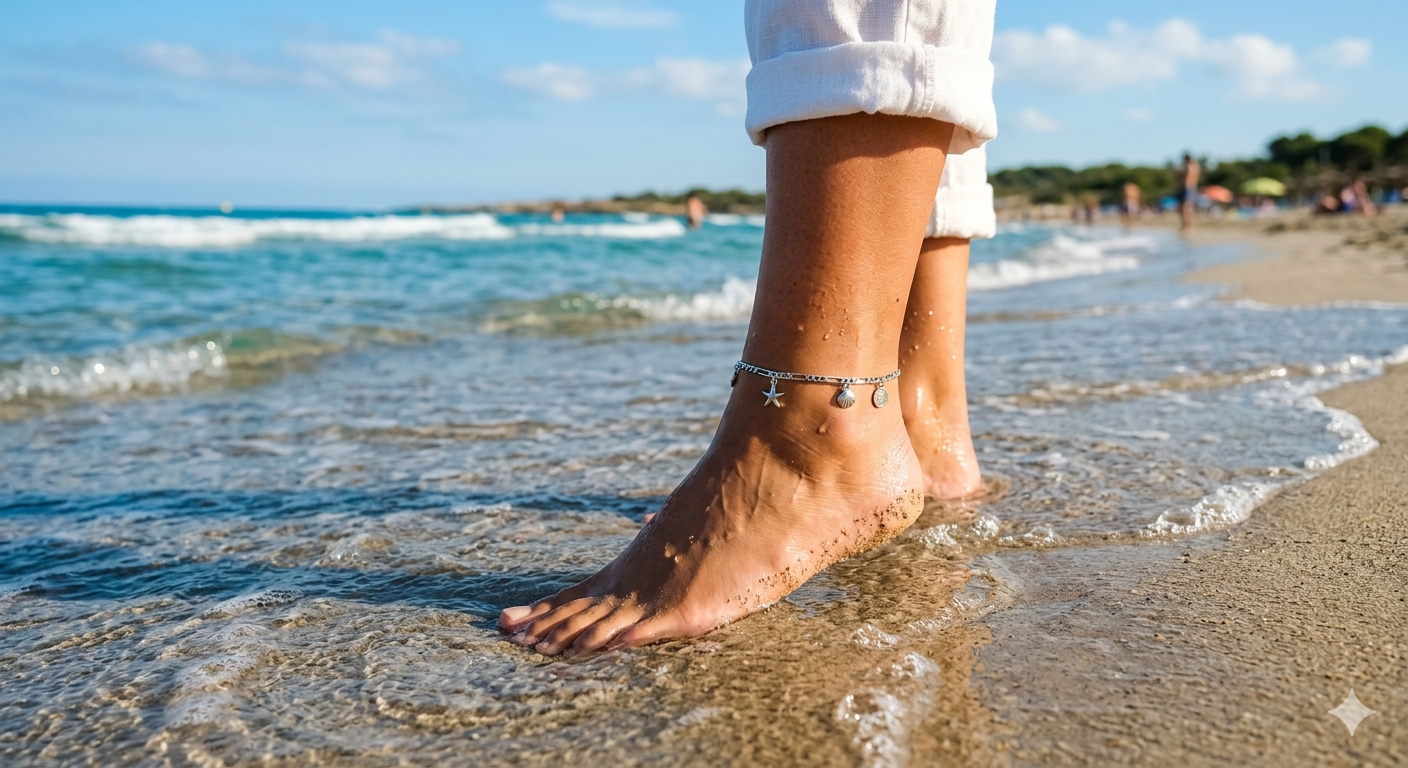
There's a moment every summer when the question resurfaces. You've just laid your towel on the still-warm sand, you look at your right ankle – the one most exposed to salt and grit – and you hesitate. Should you take off your bracelet before going for a swim? Leave it at the bottom of your bag, risking forgetting it? Or keep wearing it, crossing your fingers that it won't tarnish in three days? For women who love ankle jewelry and who love the water, this micro-daily arbitration eventually becomes exhausting.
Stainless steel was designed precisely for this woman. The metal sometimes called "surgical steel" is today the only widely accessible material that withstands saltwater, chlorine, sweat, sunscreens, sand, and long vacation days without flinching. Not in theory: in real life, at 32 degrees Celsius, after two weeks of continuous wear in Marseille, Biarritz, or Crete. Our Stainless Steel Ankle Bracelets collection was built around this promise: a piece of jewelry you never take off, from the first morning of July to the last evening of August.
Before diving into the selection, it's important to understand why all other materials reach their limit near the water, what stainless steel concretely changes in your summer routine, and how to choose the right model according to your season's program. This guide covers all of that.
🌊 Why Saltwater Destroys (Almost) All Ankle Jewelry
Seawater is not neutral. It contains an average of 35 grams of salt per liter, which is thirty times more than tap water, and this salt acts as a corrosive agent on the vast majority of metals worn on the skin. Sterling silver 925, for example, contains 7.5% copper, and this copper oxidizes on contact with salty air: the jewelry blackens, its solder areas get pitted, and after a few swims, what looked like a bright silver sheen turns into a dull gray that no soft cloth can revive. This is physical, not a matter of quality: even a beautiful solid silver bracelet loses its luster after prolonged exposure to the sea. Read more: Why Your Ankle Bracelet Leaves a Green Mark on Your Skin (and How to Remove It).
Classic gold plating, however, suffers even more. When it's gold plating on brass – the most common solution in inexpensive summer jewelry – the gold layer is extremely thin, sometimes less than a micron, and saltwater peels it off by capillarity at the clasps and rings. The jewelry doesn't change color on the surface but begins to reveal the brass base, that coppery metal which eventually leaves a characteristic green mark on the skin. The complete guide to ankle bracelet materials details these degradation logics material by material, and the conclusion is clear: for an ankle bracelet worn in the sea, only stainless steel holds up. Read more: Titanium Ankle Bracelet: The Ultra-Light and 100% Hypoallergenic Metal Explained.
Salt, Chlorine, and Sweat: Three Aggressors That Love Your Ankles
The ankle is one of the body areas where the aggressive combination is most severe. It's the first to plunge into waves, get covered in sand, sweat inside a closed sandal at 35 degrees Celsius, and rub against the edge of a pool during a swimming session. Chlorine in public pools, in particular, is a powerful oxidant: it attacks fragile solders and thin coatings, precisely where an ankle bracelet spends its days. For a reader wondering about wearing jewelry during exercise, the ankle bracelet and sport guide also highlights how sweat concentrates minerals and accelerates the oxidation of fragile metals.
316L stainless steel, known as "surgical steel," is precisely the alloy developed to resist these three simultaneous aggressors. Its proportion of chromium (at least 16%) and molybdenum (2 to 3%) creates a passive oxide layer on the surface of the jewelry: a thin, transparent, completely invisible film that automatically reforms if scratched, protecting the metal against chemical attack from both saltwater and chlorine. It's this self-healing property that makes stainless steel age differently from other metals: it retains its color, shine, and structural integrity, summer after summer. To learn more about this topic, also see Ankle Bracelet That Blackens Skin: Why It Happens and How to Permanently Avoid It.

ANKLET JEWELRY — Silver Stainless Steel
Silver Stainless Steel Ankle Chain with Brilliant Pendant
€39.90
The raw silver of 316L stainless steel enhanced with a luminous pendant, for an ankle that sparkles in the sun even after a full day with your feet in the sand.
Discover →☀️ Summer, Beach, Pool, Shower: What Stainless Steel Really Changes Daily
The real change isn't technical; it's mental. When you wear a stainless steel ankle bracelet, you stop thinking about the bracelet. It's as simple as that. No more taking it off before showering, no more calculating before going to the hotel pool, no more panic when putting on a wetsuit, no more anxiety when storing the jewelry in a toiletry bag that will go in checked luggage. The beach ankle bracelet guide sums it up well: the promise of stainless steel is the end of the removal ritual.
For many women, this detail changes everything. You go on vacation with a single ankle bracelet, chosen on the morning of departure, and you wear it for fifteen days straight. You see it in photos of sea outings, you glimpse it by the pool, you barely feel it when you fall asleep in the hammock. The jewelry becomes a small sign of identity rather than a decorative object you manipulate. To understand this difference between occasional bracelets and permanent wear bracelets, the article summer ankle bracelet vs. daily ankle bracelet explains very well how usage dictates the choice of material.
The Sensitive Skin Argument: Finally a Metal That Doesn't React
There's an often-overlooked audience for whom stainless steel is truly liberating: women with sensitive skin. If you've ever had redness under a gold-plated ankle bracelet, if you've seen your ankle break out in small blisters after a hot day, you know how frustrating it is to have to forgo summer jewelry. The sensitive skin and ankle bracelet guide details the materials to avoid and the solutions, and 316L stainless steel consistently appears as the safest option. The reason is simple: its nickel is trapped within the crystalline structure of the alloy and is practically not released onto the skin, even when exposed to sweat.
Practically speaking, for a woman who has spent ten years buying and discarding ankle bracelets because they triggered allergies, switching to a stainless steel selection is often a relief. The jewelry can be worn continuously, day and night, in seawater, in the sand, without triggering any skin reaction. The comfort is both physical and mental.
Permanent Wear Tip
If you're buying your first stainless steel ankle bracelet with the idea of never taking it off again, choose a sturdy lobster clasp (never a magnetic clasp) and opt for a chain at least 1.5 mm thick. Chains that are too thin (under 1 mm) eventually break at the clasp after a few months of continuous wear, even if they're made of stainless steel. To help you choose the right thickness for your ankle, the ankle bracelet and body type guide details the model/silhouette correspondences.

ANKLET JEWELRY — Minimalist
Minimalist Steel Ankle Bracelet with Pearl Pendant
€34.90
The discretion of a delicate chain and the softness of a white pearl: the ankle companion you keep on in the shower, at the office, and in bed without ever thinking about it.
Discover →👙 Which Stainless Steel Model to Choose Based on Your Summer Plan
Not all stainless steel ankle bracelets are created equal, and the right model largely depends on your season. A woman spending two weeks on the Atlantic coast with a swimsuit and pareo doesn't need the same jewelry as a woman alternating light sandals and heels on a Parisian terrace. Here's how to map out your choice.
For the Beach and Swimsuit: The Delicate and Luminous Ankle
If your summer mainly involves having your feet in the sand, you're looking for jewelry that catches the light without being too flashy. A delicate silver stainless steel chain, adorned with a small brilliant pendant, is ideal: it sparkles in the sun, doesn't get tangled in the sand, and remains completely discreet under a swimsuit. You can pair it with a second piece like a shell ankle bracelet for a very summery layered look, provided the shell is also mounted on nylon thread or a stainless steel chain – otherwise, the shell jewelry will suffer where the stainless steel won't.
For the City and Summer Suit: The Minimalist That Goes Everywhere
If your season mainly takes place in the city, at a cafe terrace, or in an air-conditioned open-plan office, you're looking for an ankle bracelet that is noticeable without being ostentatious. A fine stainless steel chain with a single detail (pearl, cubic zirconia, small ring) is enough to complete the look without clashing with structured clothing. Our Ankle Bracelets collection offers several versions; but for permanent wear, the classic 316L stainless steel mesh remains the most durable and practical to pair with other jewelry.
For Long Vacations: The Visible Multi-Layer Chain
If you're going away for two or three weeks and want jewelry that stands out in all your photos without needing to be changed every evening, opt for a multi-layer stainless steel chain. Multi-layers add volume and presence to the ankle even under water sandals or bare feet, and the mix of finishes (PVD gold and black, for example) allows it to be paired with almost any outfit. This is typically the kind of jewelry you pack light in a backpack and wear from the first to the last day of your vacation.

ANKLET JEWELRY — Multi-layer
Multi-Layer Gold and Black Ankle Chain
€24.90
The contrast of PVD gold and intense black for a confident ankle all summer long, visible as soon as your sandals come off and your feet touch the sand.
Discover →✨ Our Stainless Steel Selection to Stay with You All Season
Our Stainless Steel Ankle Bracelets collection was designed to cover these three summer uses and several in-between. You'll find raw silver chains for those who want the cool sparkle of pure stainless steel, PVD gold-plated models for those who like the warmth of gold without the fragility of gold plating, and multi-row compositions for those seeking a statement piece. The entire collection is made of 316L steel, the only one to offer a true price-resistance compromise for continuous use at sea.
For women who are still hesitating between silver and steel, the complete guide to stainless steel ankle bracelets delves deeper into the technical and stylistic comparison: differences between 304 and 316L, the behavior of PVD finishes over time, and minimal maintenance required. It's the ideal complementary reading before finalizing a seasonal choice. To place steel within the global ecosystem of ankle jewelry, the ultimate guide to ankle bracelets and ankle chains maps out all materials, styles, and uses, and remains the best starting point.
Beyond the steel selection itself, some women complete their summer jewelry with a delicate ankle chain as a second layer, to create that subtle double-row effect visible as soon as the sandal slips off on the terrace. The rule, then, is simple: if you want to be able to swim with both pieces of jewelry without removing them, both must be made of stainless steel. Mixing a gold-plated chain and a stainless steel chain on the same ankle means condemning the first one to ruin by the end of summer. To learn more about this topic, also see Ankle bracelet and pregnancy: which to wear, how to adapt, and what to avoid.
If you reach the end of this article and the evidence becomes clear — you want a piece of summer jewelry that you won't remove, that will withstand salt, sand, and chlorine without aging a single day — then all that's left is to let yourself be tempted by our stainless steel selection. The promise is kept by the metal itself: you'll put it on the first morning of summer, and it will still be there at the beginning of autumn.

