

Cart
0
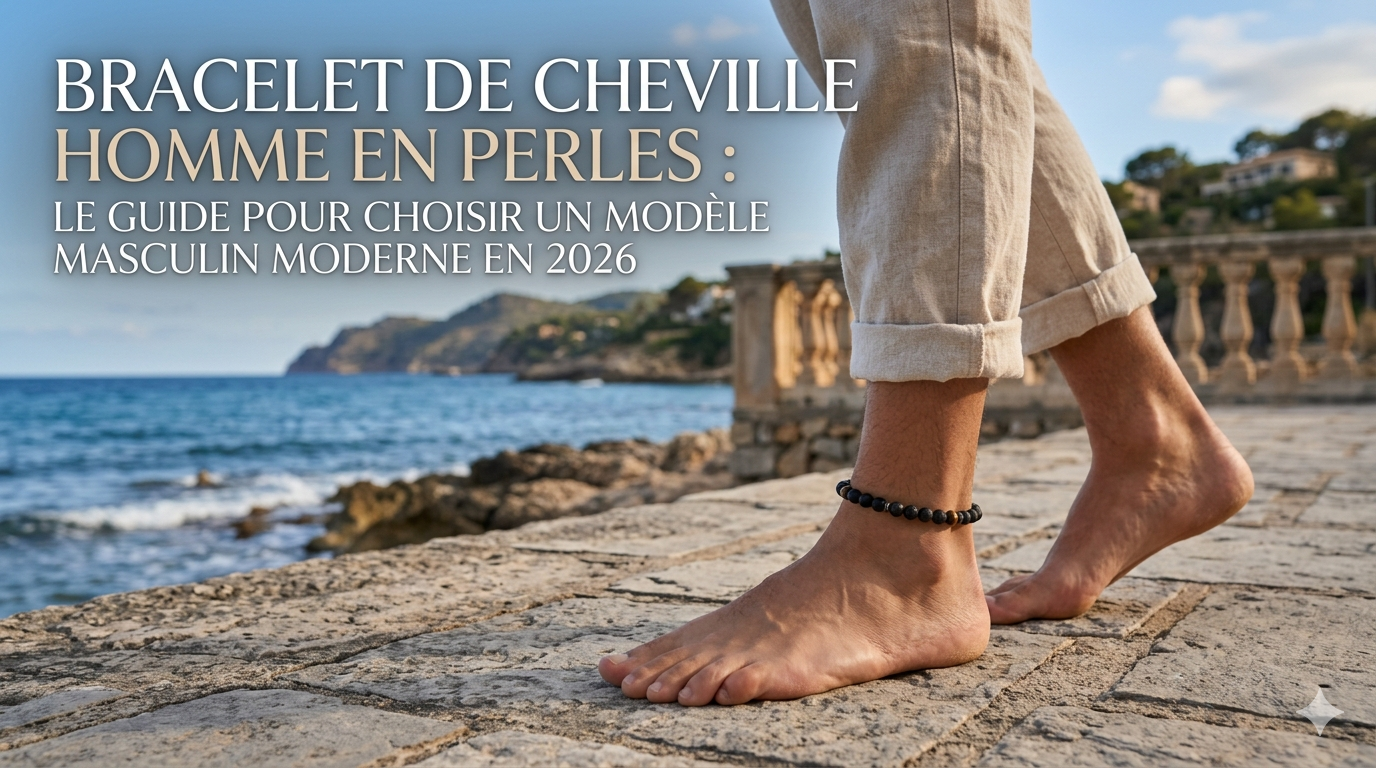
Long confined to feminine realms, pearls are making a strong comeback on men's ankles. Not the shiny pearls for formal evenings: but the pearls worn daily, raw, organic, almost polished by the sea itself. On a man, they no longer act as "adornment" — they become a signature. If you're looking for an ankle bracelet with real character, without being ostentatious, this guide is for you.
Why pearls are (finally) making their way onto men's ankles
Pearls have long suffered from an image too polished to be invited into the masculine wardrobe. For decades, they were relegated to grandmother's necklaces, classic earrings, and bourgeois weddings. All of this has changed in two or three seasons. Men's fashion, now more liberal in its approach to jewelry, has seen pearls appear everywhere — chokers, stacked wrist bracelets, and now ankle bracelets. Not perfect, lustrous Akoya pearls, no: but imperfect pearls, made of coconut, volcanic lava, wood, or shell, reminiscent of nature rather than the salon. To delve deeper into this topic, see also Matching your ankle bracelet with your other jewelry: the art of harmonious adornment in 2026.
This shift is not a stylist's whim. It accompanies a broader movement towards a less stark, less mineral masculine wardrobe, richer in organic materials. The same logic that drove men towards natural stone bracelets or woven ankle bracelets now leads them to pearls. The intention is exactly the same: to add a texture to the body that is neither metal nor fabric, and that tells a story.
If you're still hesitant about the relevance of an ankle bracelet itself for a man, the article how to wear an ankle bracelet with style when you're a man answers the fundamental question. Here, we assume the desire is there, and we examine what the pearl changes in the final result.
Another interpretation of masculinity
The pearl ankle bracelet offers an interpretation of masculinity that is neither harsh nor showy. Where a steel or silver chain plays the card of visible solidity, the pearl plays that of depth. It suggests a man who has nothing left to prove — who can afford a soft, irregular, almost living material, without fearing that he will be perceived as less virile. This is probably why this piece appeals so much to men in their thirties and forties, who are looking for a piece of jewelry that can accompany them for a long time without drawing too much immediate attention.
Recognizing a truly "masculine" pearl: materials, shapes, energy
Not all pearl ankle bracelets are created equal, and the vast majority of those seen in stores are designed for feminine wrists or ankles. For a pearl to work on a man's ankle, three elements really matter: the material, the shape, and the palette.
First, the material
Avoid perfectly round and shiny pearls, which belong to the realm of formal feminine jewelry. Opt for organic pearls: oiled wood, coconut, volcanic lava, hematite, onyx, dark agate, baroque freshwater pearls, or raw shell. These materials have one thing in common: they retain their original texture; they do not try to imitate luxury. On a man's ankle, they make sense because they resemble what nature already produces — not what has been polished for sale.
The most suitable pearl ankle bracelets for men almost all play on the same chord: matte material, assumed irregularity, a restrained palette. This is the exact opposite of the ceremonial pearl necklace.
The shape: imperfectly round or tubular
Two silhouettes work particularly well. The round but irregular pearl, like lava or coconut pearls, which gives the impression of an object found on a beach rather than a manufactured item. And the tubular pearl, rarer, found in some models inspired by tribal jewelry. Both have the advantage of remaining discreet when in motion: no aggressive light reflection, no "princess necklace" effect on the ankle.
The palette: dark, earthy, or monochrome
An adult man almost never wears bright multicolored pearl ankle bracelets. The palette that works falls into three families: dark (black, charcoal gray, very dark brown), earthy (sand, warm brown, off-white), and off-white monochromes for tanned skin in summer. Any deviation from these families makes the jewelry lean towards feminine or childish — which is not a flaw in itself, but it deviates from the subject here.
The right reflex:
Before buying, place the pearl on your ankle and observe from a distance. If it "disappears" into your tanned skin while remaining legible when approached, it's the right one. If it flashes from ten meters away, it's probably not for you. This logic also applies to shell models and pearl-shell mixtures that we will see later.

ANKLET — Black Pearls
Men's Black Pearl Ankle Bracelet
€26.90
The understated reference: matte pearls, perfectly round but without any shine, a discreet elastic thread, and just enough presence for the ankle to be noticed without focusing on the jewelry. To be worn with low-top sneakers, light shorts, or barefoot on the beach.
Discover →How to wear it: style and morphology tips
Having the right bracelet is useless if it's not worn well. On the ankle, even more so than on the wrist, two or three centimeters make the difference between a piece of jewelry that adds style and one that seems to float in the wrong place. Here's how to assess your own ankle and choose the length, wearing height, and combination that works.
Measure your ankle before buying
The average male ankle circumference is between 23 and 27 cm. The simple rule is to add 2 to 3 cm to your ankle circumference to get the ideal bracelet length when closed. Too short, it will mark the skin and cut the silhouette; too long, it will slide onto the foot and lose all visibility. If you've never measured, a flexible tape measure is sufficient, passing it above the ankle bone. To fully understand the structural differences before choosing the material, the difference between an ankle bracelet and an ankle chain is a useful read, as it lays the groundwork for how you will then wear a pearl one.
What to pair a pearl ankle bracelet with
Three combinations stand out. The first, and simplest, is with light low-top sneakers, shorts or rolled-up jeans, with the bracelet visible just above an invisible sock. An approach similar to wearing a gold ankle bracelet without appearing too much: it's the contrast between a very neutral shoe and a textured piece of jewelry that draws the eye, never the other way around.
Second combination: barefoot with slim sandals, espadrilles, or leather flip-flops. Here, the pearl is fully visible, and the ankle becomes the focal point of the silhouette. This is typically the "summer by the sea" combination, where the bracelet fully serves its function as a vacation object. The article ankle bracelet while traveling provides some useful precautions for models that travel with you.
Third combination, more unexpected: light tailored trousers, moccasins without socks, and very dark pearl ankle bracelets glimpsed just under the hem. This style is less obvious, more demanding too, but it works very well on a man who knows how to play with contrasts: the formal side of the trousers contrasted by the natural side of the pearl.
Adapting how you wear it according to the season
A common mistake is to put away the ankle bracelet as soon as summer ends. This is a shame: masculine pearls, especially in dark shades, work very well in autumn and even early winter, provided you adapt what you wear around them. In September-October, replace sandals with soft shoes like light derbies or low boots, and wear the bracelet just above thin socks. It remains visible without having to expose yourself, and that's precisely what makes the difference with a man who would only wear it three months a year.
Winter is more delicate, but not impossible. In this season, the bracelet is no longer publicly visible: it becomes an intimate presence, felt against the skin, discovered when you return home. Many men who wear it daily never take it off for this reason. In spring, one simply returns to a freer style: canvas slippers, rolled-up trousers, and the pearl resumes its visible function. This year-round continuum is one of the big differences between organic pearls and seasonal jewelry: it doesn't need the sun to exist.

Five criteria to check before buying (and the models that meet them)
The market for men's ankle bracelets has exploded in two years, and with it, the number of poorly designed models. To avoid mistakes, five criteria are enough to distinguish a piece you'll keep for years from one you'll discard after a summer.
1. The exact length
We return to this because it is by far the most common mistake. Always check the advertised length, and if it is elastic, make sure it actually fits your ankle circumference. A pearl that floats is a pearl that gets lost. A pearl that is too tight is a pearl that gets removed after an hour.
2. The type of thread or clasp
For pearl bracelets, two schools coexist: elastic threaded directly (without clasp, slipped over the foot), and fishing line with a lobster clasp. Elastic is simpler and more discreet, but you must ensure it is of good quality, otherwise it will break after a few months. The lobster clasp is more durable but visible when the bracelet turns. Neither solution is bad — the important thing is to know what you are choosing.
3. Water resistance
If you wear your bracelet in the sea, in the pool, or simply in the shower every day, check its composition. Lava, coconut, and shell pearls resist salt water very well. Freshwater or mother-of-pearl pearls are more fragile and can tarnish. For daily use, including in water, dense mineral and organic pearls are your best allies.
4. The effect on tanned skin
Most men wear their ankle bracelets in summer, on more tanned skin. Very white pearls stand out strongly on tanned skin, sometimes too much; ivory, sand, or matte black pearls always work. If you are hesitant, choose a shade that is close to a stone color you already wear in a ring or necklace: your eye is already calibrated.
5. Signature discretion
A good men's pearl ankle bracelet must remain "within the frame": visible when looking at the ankle, but invisible when looking at the entire silhouette. This is exactly what men attracted to this type of jewelry are looking for — not a display, but a detail to discover. This logic is common to all men's ankle bracelets, as already seen in the top 10 ankle bracelets of 2026, which mixes women's and men's without a strong break.

MULTI-STRAND — Beads & Shells
Multi-Strand Bead and Shell Anklet
€27.90
For those who want to make a real statement on their ankle. Three strands combining clear beads, natural shells, and subtle accents: this is the bracelet that transforms an open summer shoe into a sophisticated silhouette. Especially striking on tanned skin.
Discover →To go further: continue your exploration
The beaded anklet is a gateway. Once adopted, you quickly discover that it calls for other materials and other formats. You can pair your beaded model with a pendant model on the opposite ankle to break the symmetry, or alternate seasons by switching to a more structured steel chain as soon as cooler weather arrives.
To explore the masculine offerings more broadly, the Men's Anklets collection brings together all models designed for men's ankles: beads, chains, woven, stainless steel, braided leather. You will find overall stylistic coherence: nothing flashy, nothing verbose, everything relies on material and finish.
And if you're still hesitating between pearls and another material, the complete anklet guide provides an overview of uses, lengths, associations, and allows you to make a decision without rushing. Pearls have the particularity that they never go out of style: a well-chosen piece will remain relevant in five years as it is today. This is probably the strongest argument for taking the plunge now.
In summary
Men's ankle pearls are not a passing fad. They represent a fundamental shift in men's relationship with jewelry: less ostentation, more substance. Choose dark or earthy, organic, the right length, and worn with a neutral shoe. The rest will come with use — it's by wearing it that you'll find your own version.

