

Cart
0
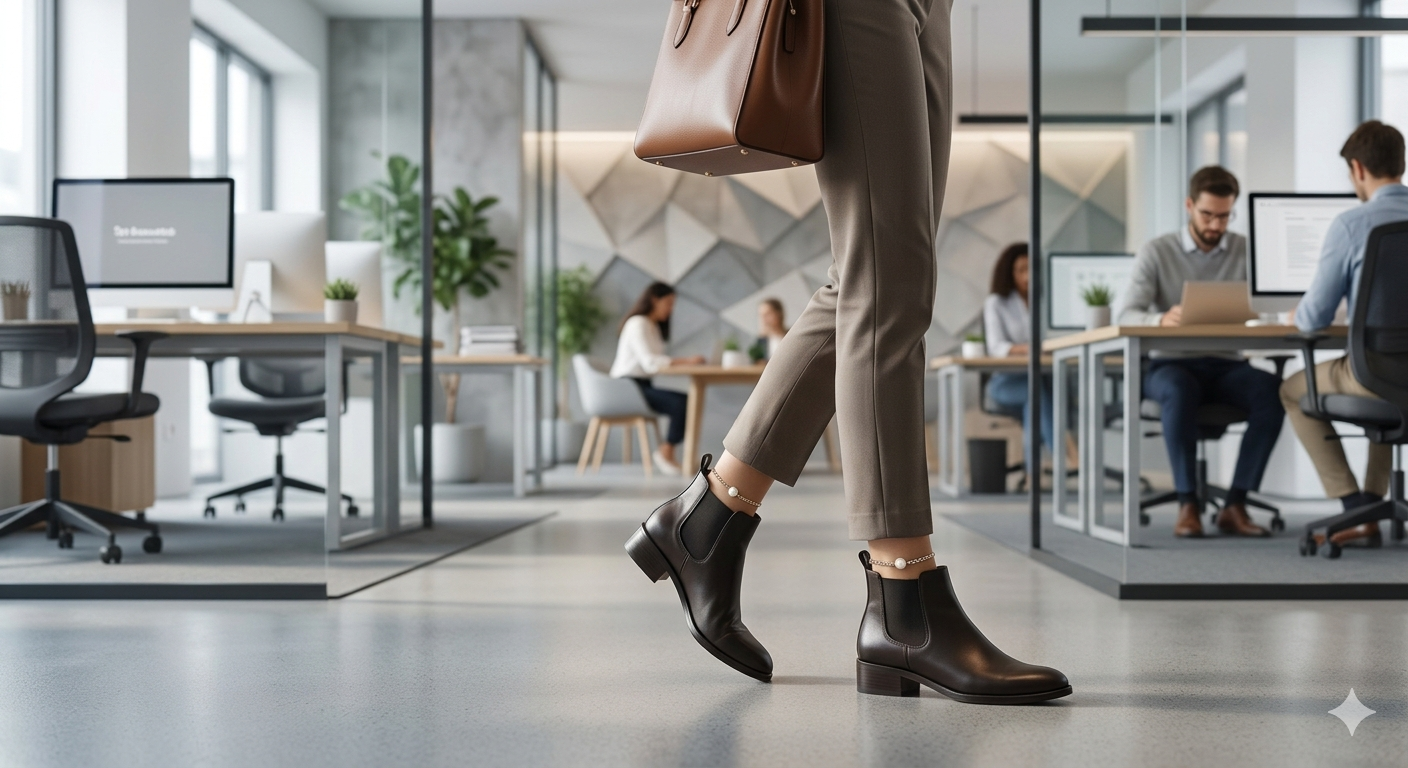
You love your anklet. You wear it on weekends, holidays, and evenings out. But on Monday morning, in front of the mirror, the question returns: can I keep it on for work? And if so, which one? What length, what color, what material, what level of visibility? No one around you really talks about it, and office dress codes have changed so much in the last five years that the old rules no longer apply. This article clearly and directly answers the most frequent question from active professional women: yes, you can wear an anklet to work, provided you choose the right model for the right context. Here is the complete method. To learn more about this topic, also see Where to buy an anklet in France: all channels compared. To learn more about this topic, also see Rolo, Figaro, Curb: ankle chain link types to choose from. To learn more about this topic, also see Ankle or wrist: where to wear your bracelet, and can you wear both?.
The quick answer. Yes, an anklet can be worn in the office. Opt for delicate 925 silver or gold-plated stainless steel, without noisy pendants, an adjusted length (+1 cm), worn under trousers or with tights. Avoid flashy bohemian styles, shells, multi-colored designs, and anything that jingles with movement. The right office anklet is one that is only noticed when you want it to be.
Anklets at the office: the real debate
Before diving into concrete solutions, it's important to understand why the question still arises in 2026, even as dress codes have radically relaxed in most French companies.
A recurring question
Type "anklet office" into Google and you'll see dozens of forums, Reddit threads, Cosmopolitan or Madame Figaro discussions where the same question comes up: Is it too much? Is it inappropriate? Will my boss find it vulgar? This persistent question is not trivial. It reflects a real area of uncertainty: between the historical image of the anklet, associated with beaches and summer outings, and its current image, which has become much more sophisticated, the perceptual gap creates permanent doubt.
This doubt mainly affects women between 25 and 45, those who work in sectors where appearance matters but where they want to maintain their identity. Tertiary sector executives, lawyers, consultants, bankers, teachers, healthcare professionals: so many professions where a fashion faux pas can be significant, and where each person must decide for themselves what is acceptable and what is not.
Dress codes have changed profoundly
In ten years, the office has changed its face. The strict suit has given way to the fluid suit, the tie to the no-tie suit, the white shirt to the oversized colored shirt. Remote work has blurred the lines between home attire and professional attire. Casual Friday has spread throughout the week in most startups and even in some large companies. As a result, personal jewelry has gained a lot of ground. The watch has become an accessory, the statement ring has become widespread, discreet piercings no longer shock anyone, and the anklet is part of this general trend of reappropriating the body at work.
This movement is not anecdotal. It is based on a deep cultural shift: we no longer ask ourselves if we "have the right" to wear a piece of jewelry, we ask ourselves if the jewelry is well-chosen for the context. The question is no longer forbidden or authorized. The question is: appropriate or not.
What the labor code says (and doesn't say)
Legally, the French labor code says nothing specific about jewelry. An employer can impose an outfit, but only if this obligation is justified by the nature of the task and proportionate to the desired goal. Specifically, except for specific sectors (food industry, hospital, certain technical professions where jewelry can snag or contaminate), no company can forbid you from wearing an anklet. And even in these sectors, it is visibility and safety that are at stake, not the existence of the jewelry itself: worn under a closed shoe, it becomes invisible.
The real constraint is therefore cultural, not legal. And culture can be navigated. To understand all facets of this universe, the complete guide to anklets and ankle chains provides the historical and stylistic foundations to build upon.
What anklets are compatible with work
Not all ankle chains are suitable for a professional environment. The basic rule: your anklet should be visible without being surprising, and easily forgotten without frustration. Here are the criteria that make a difference.
Implicit industry codes
Before choosing a model, identify your industry. In finance, consulting, law, and regulatory public services, codes remain conservative: fine silver, light yellow gold, and no flashy pendants are preferred. In communication, marketing, design, fashion, and tech, codes are much more permissive: a colorful bracelet, a woven cord, or a shell can pass without any problem. In socio-medical professions, codes are more practical than symbolic: anything that is not likely to snag a patient or an instrument is acceptable.
This framework is not a law, but a compass. If you are starting a new job, observe your colleagues for two weeks before experimenting. If you have been settled for a long time, you already know.
Criterion #1: sound discretion
This is the criterion that no one mentions, yet it eliminates 80% of unsuitable models. An anklet that jingles with movement involuntarily and persistently draws attention. In a silent meeting, in a concentrated open-plan office, in front of a client, this regular micro-noise becomes annoying for others and embarrassing for you.
To avoid this, steer clear of models with multiple metal charms, multi-strand designs where chains knock against each other, and pendants that hang far down. Prioritize simple chains, unified models, welded bracelets, or those with a single small, lightweight pendant. If you move your ankle next to your ear and hear something, it's too much.
Criterion #2: visual discretion
Visual discretion does not mean total invisibility. It means your anklet doesn't scream at first glance. There's an ideal zone: present enough to be a signature detail, delicate enough not to become the topic of conversation. This zone corresponds to chains less than 2mm thick, pendants less than 8mm high, and neutral or subtle colors. Our article on minimalist anklets and the look they inspire offers more insights into this fine line between discreet and invisible.
The simple test: take a photo of your ankle with and without the anklet. If the difference is obvious from two meters away, it's too much. If it's subtle without being overpowering, it's just right.
Materials to prefer at the office
Three materials dominate the professional world: 925 silver, plated stainless steel, and genuine fine gold or high-quality gold plating. These three materials share the same qualities: they don't oxidize during the day, don't mark the skin, don't stain tights, and don't bleed onto clothing. 925 silver remains a safe bet: neutral, durable, elegant. Our comparison 925 silver or gold-plated, which to choose helps decide between the two finishes.
Avoid for the office: colorful woven cords (unless in creative sectors), entire shells (immediately evokes beach imagery), overly vibrant stones, multiple charms visible from ten meters away. To delve deeper, our guide on anklet materials details each option.

How to wear it according to your professional environment
With the theory established, let's move on to the practical. Depending on your outfit, your position, and your day's rhythm, an anklet can be worn in very different ways. Here are the five most common configurations, with the right reflexes for each.
With a suit, skirt, and tights (classic office)
This is the most subtle and powerful configuration. The anklet is worn under tights, where it becomes a personal secret. You feel it with every step, you know it's there, and no one else sees it. It's a mini-intimate ritual, almost sensual, that subtly changes your relationship with your day. The ideal length in this configuration is adjusted (only +1 cm), so that the anklet doesn't move under the tights and doesn't twist.
For colder periods, our article on how to elegantly wear an anklet in winter specifically addresses the question of wearing it under tights, and provides concrete tips to avoid snags.
With trousers (executive, manager, support function)
Under trousers, the anklet only appears with movement, when the hem rides up slightly as you walk. This is probably the most appreciated configuration: visibility is random, and therefore intriguing. You forget the jewelry, and it reveals itself at times on your ankle when you cross your legs or stand up. No one complains, many notice it positively.
If you wear the anklet over your trousers (yes, it's done, and it's even a strong trend in 2026), read our guide on wearing an anklet over jeans or trousers before trying it in an office context. It's more daring and requires true stylistic coherence.
With professional jeans (casual office, tech, startup)
In casual office environments, like startups or creative agencies, you have the most leeway. Fitted jeans, open loafers, or white sneakers: your anklet can be more visible, more original, sometimes even colorful. This is an opportunity to dare a delicate woven cord, a gold-plated steel with a small pendant, or even a discreet shell in the summer season. The limit remains sound discretion: no jingly charms in meetings.

For men in suits or business attire
For men, the question is even more taboo and therefore even more interesting. An anklet under a suit remains extremely rare in France, whereas it has become common in Italy, Spain, and parts of the United States. Wearing one is claiming a discreet, almost secret personal refinement. Under a high sock and suit trousers, no one sees it. But you know it's there.
For more casual profiles, open summer shoes or low-top sneakers allow for controlled visibility. Our article on men's anklets and how to wear them with style delves into all masculine codes, including the professional dimension.

Remote Work vs. In-Office
Remote work changes everything. No one sees you. You wear whatever you want. Many women take advantage of remote work to wear styles they wouldn't dare to wear in the office: multi-strand, vibrant stones, charms. It's an excellent playground for stylistic learning. In the office, you stick to office-compatible styles. While remote, you test your boldness.
This alternation also creates a positive effect: your office bracelet becomes a true work bracelet, ritualized, almost standardized, and your home bracelet becomes an object of personal pleasure. Two distinct roles for two different pieces of jewelry.
Client Meeting, Professional Event, Conference
For moments of high external visibility, always simplify. A meeting with a new client, a conference where you speak, a business dinner: these are contexts where your professional image is built in a few seconds. In these moments, your bracelet should be present but understated. Fine 925 silver, without a pendant, or a soldered design that doesn't move at all. You maintain your signature, you don't create any visual interference.
The Ideal Office Bracelet: 5 Essential Criteria
If you were to buy only one ankle bracelet specifically for the office, here are the five criteria that make the difference between a good choice and a regret. Taken together, they define what, in 2026, is the ideal professional ankle bracelet.
Discreet, but not Invisible
A completely invisible bracelet is of no interest. The goal is not to hide it, but to wear it for yourself. A good office bracelet has a real physical presence: you feel it on your ankle, you see its shine when you cross your legs. But it doesn't announce itself when you enter a room. This is the difference between a shield-jewelry (which hides) and a signature-jewelry (which reminds).
Material That Doesn't Oxidize During the Day
An office day means 8 to 10 hours of wear, sometimes with stress, perspiration, tap water, soap. Not all materials hold up. Genuine 925 silver blackens slowly but is easily cleaned. Quality 316L stainless steel resists everything, indefinitely. Real gold keeps its shine without maintenance. Conversely, avoid cheap plating that turns green in two weeks, synthetic cords that deform, and stones that tarnish under artificial neon light. To learn more on this topic, also see Men's ankle bracelet in steel or silver: the complete comparison for choosing well. To learn more on this topic, also see Stainless steel ankle bracelet and seawater: the only jewelry you won't take off all summer.
Precise Adjustment System
In the office, your ankle moves and changes volume throughout the day (swelling after several hours standing, air conditioning tightening, heat expanding). A bracelet with an adjustment ring of 3 to 4 cm becomes essential. You wear it tight in the morning, loose at the end of the day. To fully understand the adjustment mechanism, our guide to choosing the perfect ankle bracelet covers the entire topic of length and adapted wear.
Compatible with Other Jewelry
You probably wear a watch, perhaps a ring, a necklace, earrings. The ankle bracelet must fit into this metallic coherence. Mixing silver on the ankle and gold on the wrist is possible but requires clear intention, otherwise it looks messy. The simplest: choose an ankle bracelet in the same metal as your watch. You avoid 90% of missteps. To learn more on this topic, also see Matching your ankle bracelet with your other jewelry: the art of a harmonious set in 2026.
The Final Test: What if Someone Notices?
Ask yourself a concrete question: if a colleague or client notices your ankle bracelet and comments on it, are you ready to respond with ease? If so, the design is good. If you feel embarrassed at the mere thought of it being mentioned, then the design is not suitable for your comfort level in this context. Psychological security is as important as technical criteria.
For most situations, a colleague's spontaneous comment will be positive: "Nice bracelet." You thank them. Next conversation. No drama. If the design is too visible, the comment can become a topic, and the topic can become a label. The line is subtle but real.
Finding Your Ideal Office Bracelet
To explore the complete selection of styles compatible with professional use, browse our collection of ankle chains, where thin and minimalist styles dominate. Lovers of durable stainless steel will find what they're looking for in the stainless steel collection, ideal for daily wear without maintenance. And to compare the entire range, our complete collection of ankle bracelets allows you to filter by material and style.
Professional men will find their selection in the men's ankle bracelet collection, with minimalist woven styles suitable for both suit wear and casual attire. And if you want to consider the level of visibility you assume, our article on wearing a gold bracelet without looking "too much" provides moderation benchmarks that work everywhere, including at work.
Wearing an ankle bracelet in the office in 2026 means asserting a personal, intimate, chosen femininity or masculinity. It's neither provocative nor inappropriate. It's simply an act of identity in a professional world that has learned to accept nuances. All that remains is to choose the style that naturally fits into your daily life without ever becoming a topic of conversation. You now have the criteria to do so.
To go further
TO GO FURTHER
This article is part of our complete guide to women's ankle bracelets. For a full overview, consult our ultimate guide to ankle bracelets.
Also discover our 4 thematic guides: choose · women · men · meaning.

