

Cart
0
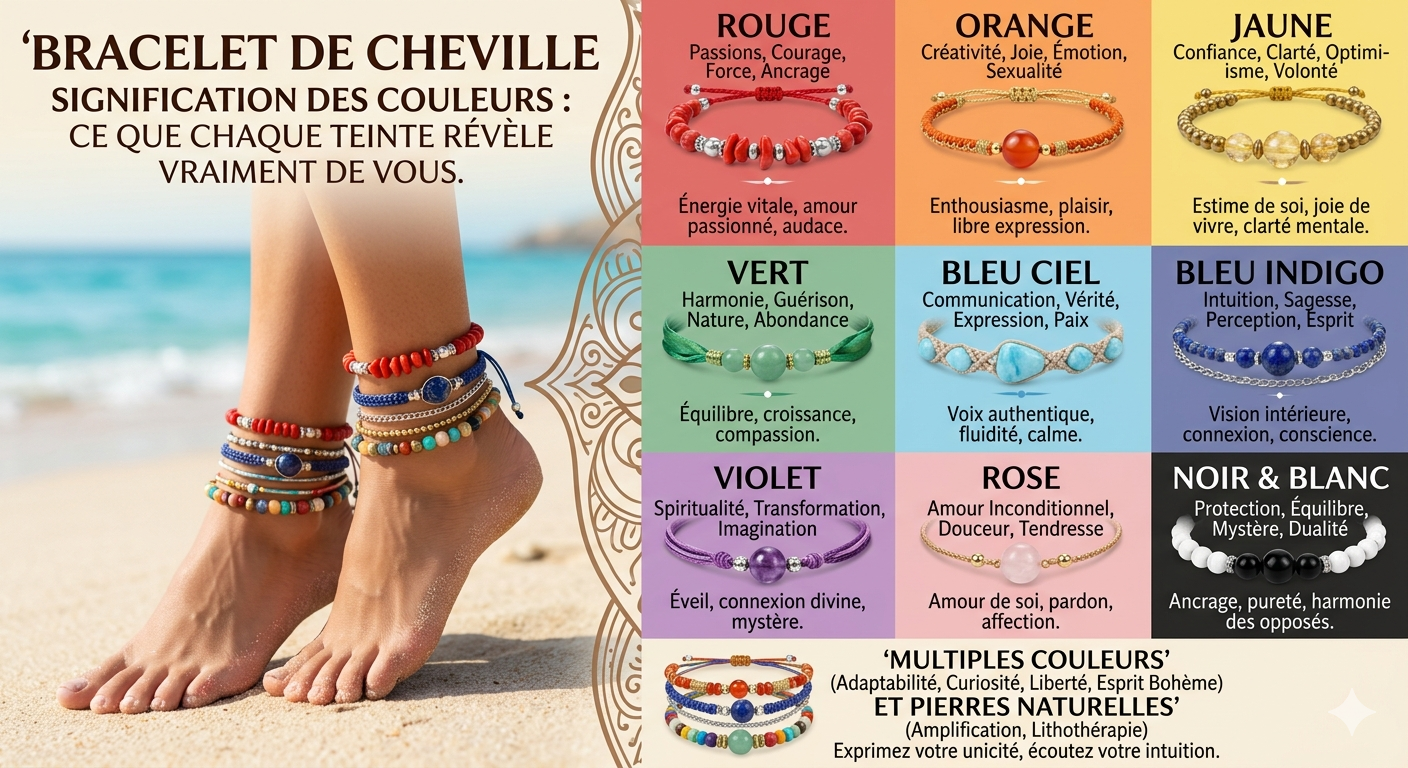
You're hesitating between a red, gold, white, or black anklet, and you vaguely sense that this choice is not insignificant. You're right. The color of a piece of jewelry is never neutral. Each shade carries a story, cultural codes, a symbolic charge that speaks volumes about you even before you utter your first word. This article is a complete guide to the meaning of colors for an anklet. Ten shades scrutinized, their history, their emotional message, what they reveal about your state of mind, and how to choose them in line with who you truly are, or who you want to become.
The quick answer. Red symbolizes passion and courage, black elegance and mystery, blue serenity, green balance, white purity, gold confidence, silver intuition, pink softness, purple spirituality, and multi-colored freedom. Choosing the color of your anklet is choosing yourself.
Why the color of an anklet is never just a detail
Before discussing each shade, let's first understand why the color of a piece of jewelry matters so much. The ankle is a visible but uncluttered area. An anklet subtly catches the eye: it's not looked at for long, but it's registered. And the first information it conveys, even before the material, pattern, or pendant, is the color.
Color, the first signal sent to the world
In the psychology of perception, it is known that the human brain identifies a color in less than 90 milliseconds. This is faster than a shape, faster than a face, almost as fast as an emotion. A red anklet doesn't say the same thing as a black or gold anklet. Before you've even opened your mouth, the jewelry has already spoken for you.
This silent communication is not marketing. It is a profound cultural reality, rooted in centuries of clothing symbolism. Our article on the meaning, origin, and styles of the anklet revisits the historical foundations. What we are doing here is an additional level of zoom: not just the anklet in general, but its specific color.
Cultural and symbolic heritage
Every civilization has developed its own color codes for jewelry. In India, red symbolizes a married woman and vitality. In ancient China, green jade represented immortality. Egyptians wore blue lapis lazuli to invoke divine protection. Roman women preferred gold to display their status. These codes have not disappeared: they have remained in the Western collective unconscious, recycled, sometimes inverted, but never erased.
This symbolic dimension goes far beyond simple aesthetics. When we talk about natural stones or materials with meaning, we enter the territory of lithotherapy and intention. Our article on anklets made of natural stones, their meanings and virtues explores this energetic aspect in more detail.
Choosing your color, an act of self-definition
Choosing the color of an anklet is not just choosing a shade that matches your outfit. It's choosing the energy you want to activate that day. It's telling the world, and especially yourself: today I'm in this state of mind, I need this balance, I claim this facet of myself. The anklet becomes a mini-ritual, almost invisible, but profoundly effective. For an overview of this entire universe, our complete guide to anklets and ankle chains remains the most structured resource available in French.
Intense colors: what they say about you
Let's start with strong shades, those that are seen, that catch the eye, that assert a powerful emotion. These are not discreet colors. These are colors of presence.
Red: passion, courage, vitality
Red is the primary color of desire and energy. In all cultures, without exception, it evokes blood, life, love, sometimes danger. Wearing a red anklet means claiming a part of boldness, showing that you are not afraid to attract attention. It is also, for many, a good luck charm: in China, the red thread protects against the evil eye, and in the Kabbalistic tradition, it wards off negative energies. The topic is covered in more detail in Red thread anklet: meaning, protection, and knot ritual.
Red suits women who embrace their strong femininity, the passionate, the lovers, those who are going through a period where they need to awaken their energy. It is also a magnificent color on tanned skin and with a white outfit in summer. Avoid it if you are looking for absolute discretion: a red bracelet is always visible, even a small one.

Black: elegance, mystery, quiet strength
Black is not the absence of color, it is their sum. In jewelry, it represents ultimate elegance, depth, mystery, sometimes power. A black anklet is never ostentatious: it makes its mark without shouting, it signals a personality that is asserted but controlled. It is the favorite color of those who like to go unnoticed while knowing they are noticed.
In lithotherapy, black stones like onyx, obsidian, or jet are renowned for absorbing negative energies and offering symbolic protection. Wearing black on the ankle is about grounding oneself, centering oneself, silently saying "I know who I am". Black is particularly well suited to urban women, introspective personalities, and those who love sharp contrasts.

Blue: serenity, confidence, depth
Blue is the most soothing color in the spectrum. Sea, sky, vast spaces. Color psychologists agree: blue lowers blood pressure, calms the mind, and evokes reliability. It is also the most used color in uniforms and institutional brands because it inspires trust.
For anklets, blue comes in a thousand shades: navy blue for seriousness, turquoise blue for escape, lapis blue for spirituality, pastel blue for softness. Wearing blue on your ankle often means claiming a certain inner peace, or actively seeking it. It is also the favorite color of sea lovers, travelers, and contemplative spirits. The iconic blue eye motif, or nazar, crosses Mediterranean civilizations as protection against the evil eye.
Green: balance, nature, renewal
Green is the color of nature, and therefore of life. Forest, meadow, young shoot. Symbolically, it evokes growth, health, renewal, hope. It is also the most restful color for the human eye, because the visual system does not have to strain to see it clearly.
A green anklet, especially made of natural stone (jade, malachite, aventurine), carries a precise energetic charge: balance of the heart chakra, openness to emotions, harmonization. It is the color of new beginnings, of people in transition, of plant and garden lovers. Green is particularly well suited to tanned skin and warm red or blonde hair.
Violet: spirituality, creativity, intuition
Violet is the rarest shade in nature, which partly explains its strong symbolic charge. The color of bishops, Byzantine kings, mystics, it is associated with spirituality, creativity, and intuition. In lithotherapy, amethyst is renowned for stimulating the third eye chakra and calming the mind.
A violet anklet is rare, and that is precisely what makes it strong. It signals a personality that thinks outside the box, a claimed creativity, a taste for the unconventional. It is the color of artists, intellectuals, and intuitive people.
Soft and neutral colors: nuances and subtleties
Now for the more discreet shades, which don't shout but speak just as much. White, gold, silver, pink, multicolored. Each carries a different universe, and the choice between them says a lot about your relationship to light, material, and femininity.
White and mother-of-pearl: purity, new beginnings, light
White is the color of purity in almost all Western cultures. It evokes light, simplicity, beginnings, marriage, sometimes innocence. Mother-of-pearl, which is not exactly white but plays with all colors under the light, adds an iridescent, almost magical dimension.
A white or mother-of-pearl anklet suits women who like sobriety, who are going through a period of renewal, who want a versatile piece of jewelry that goes with absolutely everything. It is also the favorite color of summer: on tanned skin, white literally explodes with luminosity. Shells and white pearls, in addition to their hue, bring a marine and natural dimension found in our article on the shell anklet and its symbol. Our pearl anklet collection also gathers all pearly shades, from pure white to matte black. To learn more on this topic, also see Stainless steel anklet: the complete guide to choosing durable, hypoallergenic and elegant jewelry. To learn more on this topic, also see Braided anklet: the bohemian guide to adopting the flagship jewelry of summer 2026.

Gold: confidence, abundance, celebration
Gold is the color of the sun, of wealth, of victory. Since antiquity, it has symbolized abundance, success, and the sacred. Wearing gold on your ankle is a way of asserting self-confidence, a taste for light, sometimes a festive dimension.
Warm gold suits tanned and bronzed skin, enhances brown and hazel eyes, and naturally complements summer outfits. The trap is excess: too much gold kills the gold. Our article on how to wear a gold anklet without looking "too much" gives the right proportions. And if you hesitate between real gold and plated, our comparison 925 silver or gold, which to choose settles the question.

Silver: intuition, femininity, lunar wisdom
Silver is the feminine counterpart to gold. Where gold evokes the sun, silver evokes the moon. Symbolically, it represents intuition, reflection, emotional depth, and silent wisdom. It suits fair skin, light eyes, and all seasons. It is the most versatile color for jewelry, the one you give when you're unsure, because you can never go wrong with it.
Wearing silver on the ankle often means favoring sobriety over exuberance, depth over sparkle. The silver anklets in our collection cover all variations: fine, multi-strand, with or without a pendant. To understand the difference between real silver and various alloys, our complete guide on anklet materials provides all the benchmarks.
Pink: softness, self-love, romance
Pink is the color of tenderness, self-love, sometimes childhood. Misunderstood for decades, reduced to a "girls' color," it is making a strong comeback as a symbol of asserted softness and benevolence. Wearing pink on your ankle means cultivating a tender relationship with yourself, taking care, embracing emotion without hardening.
Pink suits all skin tones, but particularly fair complexions and fresh skin. It naturally pairs with whites, beiges, and pastel blues. It's the color that immediately softens an overly austere outfit.
Multicolor: freedom, travel, optimism
Multicolor is not a color, it's a philosophy. A bracelet that mixes several vibrant shades signals a free, traveler, optimistic personality, one that refuses to choose because it loves everything. It's the color of festivals, Greek summers, Moroccan markets. It's also the color of those who aren't afraid to mix, layer, and blend styles.
Multicolor is the exact opposite of sobriety. You either own it completely or not at all. To wear it well without falling into visual clutter, our guide on layering your anklets provides the rules. And our collection of woven bracelets is full of colorful models to explore.
How to truly choose the color that suits you
Knowing the meaning of each color is useful. But how do you go from theory to your concrete choice, the bracelet you'll wear this week, this season, for years to come? Here's the four-angle method, to avoid mistakes.
According to your current intention
First question, the most important: what do you want to activate today? If you are going through a transition period and seeking stability, blue or green are your allies. If you want to awaken your energy and dare, red or gold. If you need emotional protection, black or silver. If you are celebrating something, multicolor or gold. If you are seeking inner peace, white or pastel.
This logic of intention transforms a simple aesthetic choice into a daily mini-ritual. This is the most modern and powerful dimension of jewelry: it becomes an emotional tool, not just decorative.
According to your skin tone
Not all colors flatter all skin tones. Fair skin is enhanced by silver, blue, pink, pastel. Golden and tanned skin pops with gold, red, white, bright green. Darker skin beautifully accommodates warm gold, turquoise, deep red, multicolor. This rule is not a law, just a compass. If you love a color that is not in your official palette, wear it anyway: conviction trumps theory. To delve deeper into this topic, also see Anklet and skin tone: which metal and color according to your complexion.
According to your dominant clothing style
The bracelet is never worn in isolation: it dialogues with your clothes. If your wardrobe is neutral (black, white, beige, grey), a bright color on your ankle becomes a strong signal, a signature. If your outfits are already colorful, a sober bracelet (silver, white, gold) re-frames the ensemble. If you are bohemian, multicolor and natural stones are a must. If you are minimalist, fine silver and light gold are your allies.
According to the season
Seasons have their palette. Summer calls for bright colors (red, turquoise, gold, multicolor) and luminous whites. Autumn suits ochres, deep greens, warm gold, black. Winter favors silver, navy blue, black. Spring invites pink, pastel, tender green. This seasonal logic is not mandatory, but it makes the jewelry more appropriate, more in tune with the ambient light of the moment.
What if you combine several colors?
Combining two or three colors on the same ankle, or alternating bracelets depending on the day, is entirely possible and even recommended. The basic rule: choose colors that have the same saturation. Pastel with pastel, vivid with vivid, sober with sober. Mixing a powder pink bracelet with a neon red bracelet creates a visual imbalance that is rarely pleasing.
If you want to build a collection of anklets to match different moods, browse our complete anklet collection. You'll find all the colors mentioned in this article, classified by material and style, with detailed product sheets for the exact shade and length of each model.
Color, the first word of jewelry
Choosing the color of your anklet means making a choice that goes beyond aesthetics. It's about saying something about yourself, your mood, your ambition, your emotions. Each shade carries a story, codes, a charge. What you choose today is not insignificant, and that is precisely what makes jewelry so powerful: a tiny object that speaks volumes about you, more than you might think.
Red for passion, black for mystery, blue for peace, green for balance, white for light, gold for confidence, silver for intuition, pink for sweetness, purple for the soul, multicolor for freedom. Ten colors, ten versions of you. All that's left is to choose which one feels like coming out this week.
To go further
ON THE SAME TOPIC
See also: which charm to choose for an anklet · the heart anklet, symbol of love.
TO GO FURTHER
This article is part of our large guide to the meaning of anklets. For the complete overview, consult our ultimate anklet guide.
Also discover our 4 thematic guides: choose · women · men · meaning.

