

Cart
0
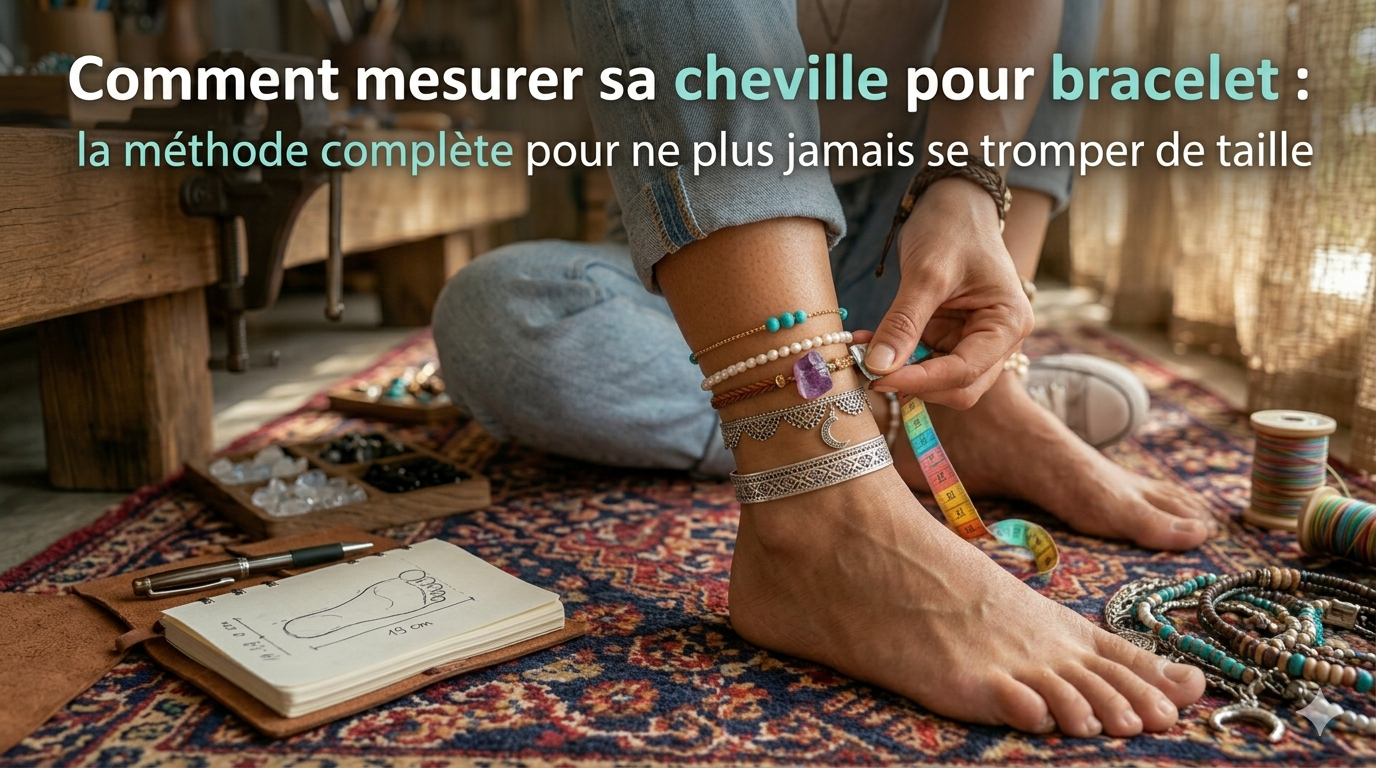
You've spotted the perfect anklet. You click "Add to Cart." And then, you freeze. What size to choose? 23 cm, 25 cm, 27 cm? Too short, the jewelry squeezes. Too long, it slips down to your foot. And you can't try it on before buying. This is the number one obstacle when ordering an anklet online. This article gives you the exact method to measure your ankle in less than a minute, choose the ideal length according to your body type and style, and never make a mistake again. With or without a tape measure. To delve deeper into this topic, also see How to Make Your Own Anklet: The Complete Beginner's Tutorial (Beads, Braiding, Cord). To delve deeper into this topic, also see Anklet: 7 Things to Check Before Buying to Avoid Mistakes in 2026.
The quick answer. To measure your ankle, wrap a flexible tape measure just above the bone, without tightening. Note the measurement in centimeters. Add 1 cm for a snug fit, or 2 cm for an anklet that drapes slightly over the foot. The standard size for a women's anklet is 25 to 26 cm.
Why the right size changes everything for an anklet
An ill-sized anklet isn't just an aesthetic detail. It's what turns a beloved piece of jewelry into one that's never worn. Too tight, it marks the skin and restricts circulation. Too loose, it twists, gets tangled in sandal straps, or ends up falling off during the day.
A well-fitted bracelet, conversely, becomes invisible when worn. You forget it's there. That's exactly the desired effect. The ankle moves constantly, more than the wrist, and jewelry in this area is constantly subject to micro-variations in circumference. The tolerance margin is therefore narrower than one might think.
The ankle is not a wrist
First classic mistake: applying your wrist bracelet size to your ankle. It never works. The ankle is on average 4 to 6 cm wider than the wrist. And most importantly, it has a different geometry. The ankle bone, the malleolus, protrudes on the sides. This bony area changes how the jewelry wraps.
If you're hesitating between the two types of jewelry, first read our comparison on the difference between an ankle bracelet and an ankle chain. You'll understand why the two models are not measured in quite the same way.
What is the standard size for an anklet?
The reference size for a women's anklet is 25 to 26 cm. This is the most commonly produced length, offering the widest choice of models. Most include an adjustment ring located at 22 or 23 cm, allowing the jewelry to be shortened without modification.
For men, the standard size goes up to 27, 28, sometimes 30 cm. The male ankle is wider, bonier, and the fit is often a bit lower, almost on the instep. Our men's anklet collection offers models specifically adapted to this morphology.
Average ankle circumference: what to expect
The ankle circumference of an adult woman is on average between 18 and 22 cm. For very slender ankles, it goes down to 16 cm. For stronger ankles, it goes up to 24, or even 26 cm. This variation is much larger than one might imagine. Two women of the same clothing size can have a 5 cm difference in ankle circumference.
That's why there is no reliable "universal size." The S/M/L marked on a product sheet is useful, but remains indicative. The only truly precise data is the measurement you take yourself, on your ankle, at a given time of day. For a global overview of the entire anklet universe, our complete guide to ankle bracelets and ankle chains gives you the basic benchmarks before purchase. This theme is further explored in Women's Anklets and Body Shape: Finding the Model That Enhances Your Silhouette in 2026.
How to measure your ankle in 4 simple steps
This method takes one minute. It works for everyone, provided you follow the four steps in order. No specific equipment required. A sewing tape measure is more than sufficient. If you don't have one, we'll see how to do it with what you have on hand right after.
Step 1 — Choose the right time
The ankle's circumference varies throughout the day. In the morning, it's at its smallest size. In the evening, after several hours of standing, it can swell by 0.5 to 1.5 cm. In summer, with high heat, the phenomenon intensifies. If you measure in the morning and order based on that, your anklet will feel tight by 6 PM.
The right approach: measure in the middle of the day, around 1 or 2 PM, when your ankle is at its average size. If you plan to wear the anklet primarily in the summer, measure in the afternoon. If it's for winter and indoor wear, the morning is fine. Ideally, take the measurement twice, at two different times, and keep the larger of the two.
Step 2 — Locate the right spot
Where you measure makes all the difference. The ankle doesn't have the same circumference at the top, middle, or bottom. The exact anatomical landmark is the malleolus: that small, round, prominent bone on the inner and outer side of your ankle. You can feel it under your fingers.
Measure just above the malleolus, in the thinnest part of the ankle. This is where the anklet naturally sits when you put it on. Avoid measuring too high, otherwise you're measuring the base of the calf, which can be 2 cm wider. Also avoid measuring too low, on the instep, unless you explicitly want jewelry that drapes over the shoe. For further reading: Foot Chain: The Jewelry Connecting Ankle to Toes (History, Styles, and Adjustment).
Step 3 — The precise gesture
Sit down, leg slightly extended or foot flat on the floor. Wrap the tape measure around your ankle horizontally, parallel to the floor. The tape should rest on the skin without indenting it. No tension. No creases. No twisting.
Read the measurement to the nearest centimeter. Write it down. If the tape is only graduated in inches, multiply by 2.54 to get centimeters. And if the measurement falls between two graduations, always round up to the next centimeter. Better a half-centimeter margin than the opposite half.
Step 4 — Add the comfort centimeter
The raw measurement is your ankle circumference. Not the bracelet length to order. You need to add a margin. This margin depends on how you want to wear the jewelry.
For a snug fit, close to the ankle, that doesn't move at all, add 1 cm. For a classic fit, where the anklet moves slightly and drapes gently towards the foot when you're sitting, add 1.5 cm. For a loose fit, like a chain that slides over the instep with each step, add 2 cm. Beyond 2.5 cm, the anklet becomes unstable and risks falling off.
How to measure your ankle without a tape measure?
No tape measure at home? Three alternatives work very well. They give a result accurate to within 0.5 cm, which is perfectly sufficient.
The string method. Take any piece of thread, cord, ribbon, or even dental floss. Wrap it around your ankle exactly as you would with a tape measure. Mark with a pen where the ends meet. Then lay the string flat on a ruler or measured table. Read the length between the mark and the end.
The paper strip method. Take an A4 sheet of paper. Cut a strip about 2 cm wide along its entire length. Wrap it around your ankle, mark the overlap point with a pencil, then unfold and measure with a ruler. This is the most accurate method without a tape measure, because the paper doesn't stretch at all.
The banknote method, for emergencies. A €5 note is exactly 12 cm long. A €10 note, 12.7 cm. A €20 note, 13.3 cm. You place several notes end-to-end around your ankle and add them up. It's less precise, but it gives you a reliable estimate in under thirty seconds.
The size chart, at a glance
Here is the direct conversion between measured ankle circumference and the bracelet size to order. This table covers the vast majority of body types.
If you're hesitating between two rows, consider your wearing style. Someone who likes to feel the jewelry against their skin will choose the snug column. Someone who likes the bracelet to move slightly with each step will choose the loose column.

What length to choose depending on your situation
Theory is good. But real life is more subtle. A perfect measurement is not enough if you don't take into account the type of jewelry you're wearing, where you're wearing it, and how your body reacts to the seasons. Here's how to refine your choice.
What length for a women's anklet?
For most women, the target size is 25 or 26 cm. This is the most commonly produced length, offering the widest selection of models. All the jewelry in our women's anklet collection is calibrated around this reference size.
If you have slender ankles, don't force the 25 cm. Go down to 23 or 24 cm, your jewelry will look infinitely better. Conversely, if you have more pronounced ankles, comfortably go up to 27 or 28 cm. An anklet that's too short and marks the skin is uncomfortable and won't be worn.
What size anklet for men?
For men, the useful range is 27 to 30 cm. Most men will be served by 28 cm. Those with stronger ankles, or who want a very low fit, should aim for 30 cm. To learn more about style and fit, consult our guide dedicated to how to wear a men's anklet with style.
The pitfall for men is choosing too short a length for fear that it will be too visible. The result: the anklet is tight, marks the skin, and becomes uncomfortable after an hour. It's better to choose a comfortable size that can be worn daily.
For a child's or teenager's ankle
Children's and teenagers' ankles differ from adult standards. Expect 17 to 19 cm for a girl aged 6 to 10, 19 to 22 cm for a teenager, and 21 to 23 cm for a young woman with a still slender build. For these sizes, prefer adjustable models with an adjustment ring, because the ankle continues to grow.
At what height should an anklet be worn?
The height at which you wear the jewelry directly changes the size you need to order. A close-fitting anklet is positioned just above the ankle bone: take your exact measurement +1 cm. A low anklet, which rests on the instep and is visible in the shoe, requires +2 cm minimum.
The topic of positioning deserves a dedicated article, and we've written it: read it to understand which ankle to wear an anklet on and what conventions modify the fit.
Length changes with the type of jewelry
Not all anklets are measured the same way. This is what surprises most people when buying. A fine silver chain is not worn like a woven cord, and the ideal length is not the same.
A fine chain, like those in our anklet chains collection, almost always includes an adjustment ring. You have some leeway: 2 to 3 cm of tolerance thanks to the adjustment system. A woven cord, conversely, is fixed. No adjustment. Once tied, it's tied for good. Measure precisely.
A multi-strand or pendant anklet requires 1 cm more than the standard measurement, because the strands stack up and the carrying chain loses a little effective length. A beaded anklet, however, follows the exact measurement. To delve deeper, our article on anklet materials specifies how each material reacts when worn, and the one on what chain thickness to choose provides the right benchmarks for link models.
What if your ankle swells? Summer, end of day, pregnancy
The ankle is not a dead bone. It reacts to heat, walking, prolonged sitting, the hormonal cycle, and pregnancy. A variation of 1 to 1.5 cm over the day is completely normal. For some women, in summer or late pregnancy, it can go up to 2 cm.
If this is your case, measure twice. In the morning and late afternoon. Take the average, and systematically add 2 cm for comfort, not 1. Avoid models with rigid clasps. Prefer chains with an adjustment ring, which accommodate your variations. And if you plan to swim with it, check out our article on swimming with an anklet before purchasing. Saltwater and heat change the game.
In winter, the opposite phenomenon occurs. The ankle tends to be thinner, especially in the morning in cold weather. If you wear your anklet under tights or boots, read our guide on how to wear an anklet in winter to adjust the length accordingly.
Anklet size S M L: what do they correspond to?
On some product sheets, you'll see S, M, L instead of a length in centimeters. Here's the conversion used by most French brands. An S corresponds to 22-24 cm, ideal for a slender ankle. An M covers 25-26 cm, the standard size. An L targets 27-29 cm, for stronger ankles or a loose fit. XL, rarer, starts at 30 cm.
Be careful though: these equivalences are not universal. Some brands make everything in a single M with a wide adjustment chain. Others shift their ranges by 1 to 2 cm. Always check the exact length indicated on the product sheet, it's the only reliable data.

What to do if you're unsure or the size isn't perfect
Even with a perfect measurement, there's always a degree of doubt when clicking "buy." That's normal. Fortunately, there are simple rules for handling borderline cases, and concrete solutions if the size received isn't quite what you expected.
Hesitating between two sizes: the simple rule
If your measurement falls between two sizes, the rule is almost always the same: take the larger size. Why? Because a chain with an adjustment ring can be easily shortened. Conversely, enlarging an anklet that is too small requires adding an extender, which means an alteration to the jewelry.
The exception is a woven cord. No adjustment is possible. For this type of jewelry, take the closest size, or even slightly smaller if you like a close fit. Woven cords stretch very slightly after a few weeks of wear.
How to adjust an anklet that is too big?
You received your jewelry and it's 1 or 2 cm too long? Don't panic. There are three solutions, listed from the simplest to the most technical.
The first is the adjustment ring. Most chains offer one located between 22 and 23 cm. You attach the clasp not to the end of the chain, but to this intermediate ring. The anklet instantly shortens. The free end dangles at the back; this is intentional, and even an aesthetic detail.
The second is removing a link. On stainless steel chains, this can be done with fine pliers and a little patience. Allow 30 seconds per link. If you're not comfortable, a jeweler will do it for a few euros.
The third is adding an extender if the anklet is, on the contrary, too short. An extension chain of 2 to 5 cm can be easily purchased and attached to the clasp. Absolutely avoid cutting a woven cord yourself. You will destroy it, and it cannot be re-soldered.
The right habit to never make a mistake again
Measure your ankle once, and write down the value somewhere. On your phone, on a sticky note in your jewelry drawer, it doesn't matter. You'll avoid re-measuring every time you buy, and you'll save time. Re-measure once a year if your weight varies significantly, or if you are pregnant.
Before each order, check two pieces of information on the product sheet: the exact length of the anklet in centimeters, and whether or not an adjustment ring is present. These two pieces of data are enough to avoid 95% of size errors. To go further on the complete selection, our complete guide to choosing an anklet according to your style covers other criteria, beyond size.
Finding the model that matches your ankle
You now have the exact measurement, the comfort margin to add, and knowledge of standard sizes. All that remains is to choose the jewelry. To explore the entire range, browse our complete collection of anklets, where each model clearly indicates the length and clasp type.
If you're looking for an adjustable model that's easy to wear daily, women's and men's anklet chains with an adjustment ring offer the greatest tolerance. The longer the ring, the more you'll absorb circumference variations throughout the day, without the jewelry moving unnecessarily.
The perfect size is not a magic number. It's the intersection of your actual measurement, your wearing style, and the type of jewelry you like. With the method in this article, you have all three. All that's left is to choose the anklet you want, and wear it without ever having to think about it again.
To go further
ON THE SAME TOPIC
See also: choosing an adjustable anklet · gifting an anklet to a girl or teenager · wearing an anklet during pregnancy.
TO LEARN MORE
This article is part of our complete anklet buying guide. For the complete overview, consult our ultimate anklet guide.
Also discover our 4 thematic guides: choosing · women's · men's · meaning.

