

Cart
0
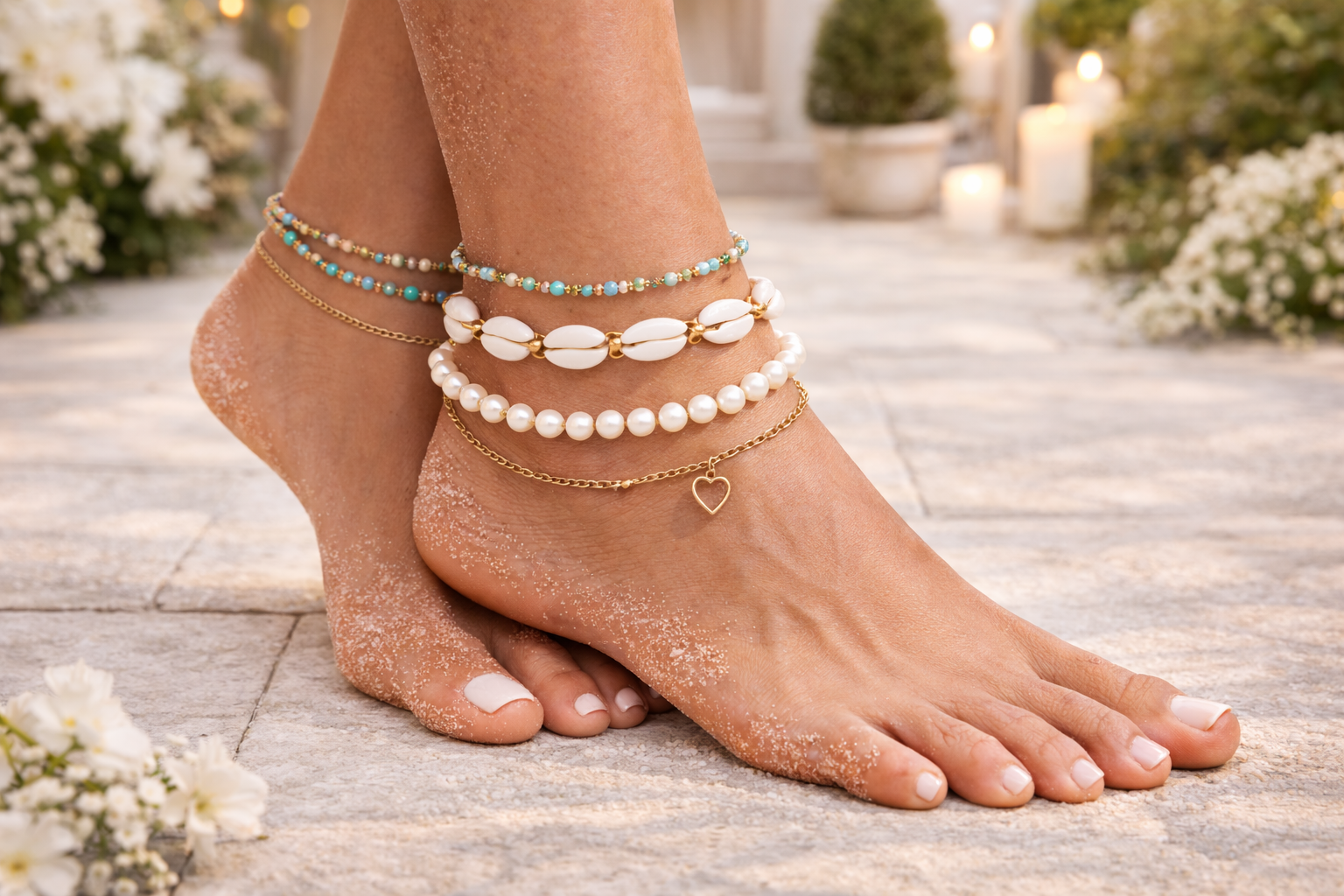
Ankle bracelet for girls and teens: what age, what size by age, what style (gift guide)
QUICK ANSWER
To offer an ankle bracelet to a girl (6-12 years old) or a teenager (13-17 years old), aim for an adjustable model in 316L stainless steel, with a clasp that she can manipulate herself and without small detachable parts before 6 years old. In terms of length, count 17-19 cm for a child aged 6-10, 19-21 cm for a pre-teen, 19-22 cm for a teenager, and 21-23 cm for a young woman. A colorful or woven cord will appeal to a child; beads and shells will attract a teenager; a delicate gold chain will delight a young woman. A budget of 15 to 35 € is largely sufficient for a quality gift.
You want to offer an ankle bracelet to your daughter, niece, goddaughter, or your teenager's friend. It's a lovely idea. But a question stops you cold: is it really suitable for her age? And above all, how do you choose the right length, the right material, the right style without making a mistake?
Don't worry. This guide was designed for you, parents and relatives, and for one specific scenario: jewelry intended for a child or a teenager. It's not the same as buying for yourself. There's a size you don't know, more delicate skin, hands that need to be able to fasten the jewelry alone, and a taste that changes every two years. We'll address these four points, in order.
From what age can you offer an ankle bracelet?
There's no official age. But in practice, an ankle bracelet becomes a real pleasure from 6-7 years old. At that age, the child understands the concept of jewelry. She knows that an object can belong to her, she likes to choose her accessories, and she is able to understand that a bracelet should be removed before certain activities. It's this last point, more than aesthetic maturity, that shifts the marker.
Before 6 years old, it's possible, but with caution. Very young children pull on everything, put small objects in their mouths, and don't yet gauge what breaks. So we stick to a simple, robust model, without tiny detachable beads, and worn under supervision rather than continuously. It's not a refusal, it's a framework.
Between 6 and 12 years old, it's the golden age of the first ankle bracelet. The child often asks for it after seeing it on an older sister, a cousin, or a friend at the pool. The ankle bracelet also has a huge advantage over other jewelry at this age: it doesn't get lost like a ring you take off to wash your hands, it doesn't get torn off like a necklace during a game, and it remains invisible under pants when the school prohibits visible jewelry. It's the most "life-compatible" piece of jewelry for a child that exists.
In adolescence, between 13 and 17 years old, its status changes. It's no longer a colorful toy, it's a fashion accessory in its own right. The teenager chooses her style, matches it with her outfits, wears it all summer and sometimes all year round. This is where the gift takes on a true emotional dimension: offering jewelry to a teenager is recognizing that she has her own taste. And if you're unsure which ankle to favor, the question can be settled in a minute in our article on which ankle to wear an ankle bracelet on — the answer is the same at any age.
KEY TAKEAWAY
The ankle bracelet is an excellent first piece of jewelry. Discreet, light, it doesn't get lost like a ring and doesn't bother like a necklace. Ideal for learning to take care of an accessory you love, without drama the day you forget it by the pool.
Is it really "appropriate" for a young girl?
This is the question many parents don't dare to ask. It deserves a clear answer: yes. An ankle bracelet is not a piece of jewelry reserved for adults, nor does it carry any implicit meanings. It's a summery, fresh, joyful accessory that has been seen on all beaches around the world for decades, including on eight-year-old girls. It's simply a pretty bracelet worn on the ankle rather than the wrist.
If a cliché is still rattling around in your head, it's already debunked elsewhere: we've dedicated an entire article to the question of vulgar or chic ankle bracelets, and the conclusion obviously applies to teenagers too. What makes the difference is never the jewelry itself, but the chosen model. A delicate thin chain or a colorful woven cord raises no questions for anyone.
Second reassurance: it's not a "one-summer" piece of jewelry either. It can be worn at all ages, as our guide to ankle bracelets at 40, 50, and 60 shows. The jewelry you give at fifteen can very well still be worn at thirty. This is an important consideration when choosing a durable material rather than a disposable model.
What size by age: benchmarks for children and teenagers
This is the big fear of a jewelry gift. Too small, it pinches. Too big, it dangles. And unlike buying for yourself, you can't run a tape measure around her ankle without giving away the surprise.
The complete measurement method — how to measure, where to place the tape, what margin to add, how to convert to bracelet size — is detailed from A to Z in our article how to measure your ankle for a bracelet. We won't rehash it here. What interests us in this guide is what this method actually yields when applied to a child or a teenager. Here's the result, age group by age group.
↔ Scroll table on mobile
A specific point about childhood: these figures change. An eight-year-old girl's ankle can grow by a centimeter in a year, and an eleven-year-old pre-teen's can change from one season to the next. So take these ranges as a reliable starting point, not as a fixed rule. This is also why an adjustable model with an extender chain remains the safest choice for this age group: it accommodates growth without the jewelry becoming unusable after a year.
The surprise gift trick: starting from her wrist bracelet
Here's the only workaround that truly works when the surprise needs to remain intact. You don't need to approach her ankle: grab one of her wrist bracelets, the one she wears most often and that fits her well, and measure its length flat. For both a child and a teenager, the ankle is generally 2 to 4 cm larger than the wrist.
EXPERT ADVICE
Wrist bracelet 15 cm? Aim for 17 to 19 cm on the ankle. Bracelet 17 cm? Aim for 19 to 21 cm. Take the higher end of the range if the wrist bracelet is already a bit tight, and the lower end if it's rather loose. You'll get a very reliable estimate, without her suspecting anything.
This wrist-ankle equivalence is no coincidence: the two types of jewelry are sized completely differently, which our comparison of ankle or wrist bracelets details. Just remember the 2 to 4 cm difference; it's enough to ensure a successful gift.
And if doubt persists despite everything, don't bet on a fixed length: an adjustable model covers several sizes at once and eliminates the problem. All our ankle chains include an extender for this custom comfort.

Child jewelry safety: four points to check
This is the core of the matter, and it's where a gift for a child radically differs from buying for oneself. An adult will put up with a stubborn clasp, a charm that moves, or a cord that fades a bit. A child, no. She'll abandon the jewelry in a drawer, or worse, hurt herself with it. Four points are enough to rule out all risks.
1. The clasp: can she manipulate it herself?
This is the most underestimated criterion, yet it determines whether the jewelry will be worn or not. A clasp that a child can't open becomes jewelry she only wears when an adult is available. In other words: jewelry she never wears.
The fine motor skills of a six or seven-year-old girl do not allow her to pinch a two-millimeter tab while holding a chain taut behind her own ankle, blindly, sitting cross-legged. It's a much more difficult gesture than at the wrist, because she can't see what she's doing and her hand is working in reverse. Around ten or eleven years old, most children can manage it. Before that, it's hit or miss.
Two systems really work for small fingers. First, a good-sized lobster clasp: large enough to be gripped between the thumb and index finger, with a tab that offers real resistance under the finger. You can spot it by eye; it's at least one centimeter. Second, the sliding knot on cord or woven thread models: there's nothing to pinch, nothing to aim for; you just slip it on and pull the two strands. It's the most autonomous system for a child, and it's one reason why cord remains unbeatable before eight years old.
Conversely, avoid tiny spring ring clasps, those small flat circles where you have to push a slider as wide as a pinhead. They're bothersome for an adult; they're impossible for a child. The same goes for screw-in bayonet clasps: the motion requires two-hand coordination that the ankle doesn't allow.
THE 10-SECOND TEST
Before giving it, close the bracelet yourself with your eyes closed, with one hand, behind your own ankle. If you can do it in under ten seconds, an eight-year-old child will also be able to. If you struggle, she'll give up.
2. No small detachable parts before 6 years old
This is the non-negotiable rule. Below six years old, any element that can detach and fit in a mouth is a risk of ingestion or inhalation. This specifically refers to micro-beads strung on elastic thread, charms attached by a simple open ring, glued rhinestones, small pierced shells that split, and decorative screw-on ends.
The test is simple and you can do it in the store or when you receive the package: pull firmly on each decorative element, one piece after another. If something moves, turns on its ring, or slightly detaches, the jewelry is not for a young child. Also, check that the connecting rings are soldered and not just closed with pliers—an open ring always ends up separating, and the charm falls off.
Also beware of bare elastic threads, which are very common on cheap beaded models. They break suddenly, often without warning, and release about twenty tiny beads at once into the room or into the sand. For a child under six, always prefer a continuous braided cord, without added beads, or a single-strand chain. After six or seven years old, the constraint loosens: charms become possible again, provided they are securely fastened. This is also the age when an anklet with a pendant really starts to be appreciated.
3. Cord and woven thread: demand certified dyes
Cord or woven thread models are often the best choice for a child, because no metal remains in prolonged contact with the skin. But they shift the safety question elsewhere: to the dyes. A cheap colored thread can bleed during the first swim and leave a blue or red mark on the ankle for several days.
What to look for is a mention of certified dye free of harmful substances, such as OEKO-TEX or equivalent, exactly like on children's clothing. Serious manufacturers indicate this, because it's a selling point. Conversely, a neon cord sold for a few euros without any information on its composition offers no guarantee, and it will be worn for weeks on end on sweaty skin, under a summer sun.
A simple check upon receipt: rub the cord with a damp white tissue. If the tissue stains, the dye is not fixed. For a child, this single test eliminates most unpleasant surprises. Those who want to go further can even make the jewelry with the child from threads chosen at a haberdashery, an activity detailed in our tutorial on how to make an anklet yourself. The gift then becomes a shared moment.
4. Material in contact with the skin
A child's skin is thinner and more reactive than an adult's, and they wear the jewelry continuously, including at night and in water. If they have ever had the slightest skin reaction to costume jewelry, take no risks: only 316L stainless steel and real gold are truly safe on young skin.
316L steel, known as surgical steel, is precisely the king material for a first piece of jewelry: hypoallergenic, free of free nickel, it withstands pool water, the sea, sweat, and sand without flinching. Everything you need to know about its qualities and limitations is gathered in our guide to durable, hypoallergenic, and elegant stainless steel, and our selection can be found in the stainless steel anklets collection.
WARNING
The details of materials to avoid and reactions to watch for cannot be covered in three lines. If the child's skin is sensitive, read our article anklet and sensitive skin: what materials to avoid. And if a reaction has already occurred, our guide on nickel allergy: symptoms and nickel-free materials will tell you what to recognize and what to choose next.
One last check before validating the cart: the seven universal control points we list in our article 7 things to check before buying an anklet also apply to the gift, in addition to the four child-specific points above.
The right style for the age: from colorful cord to delicate gold chain
A bracelet that pleases is a bracelet adapted to their age and personality. A 7-year-old girl and a 16-year-old teenager don't dream of the same piece of jewelry, and choosing the wrong style is the second biggest cause of failure after size. Here's how to hit the mark for each age group.
For a child (6-12 years old): color, cheerfulness, simplicity
Children love color. A colorful cord, a multicolored woven thread, bright beads like a friendship bracelet: it's fun, it's joyful, and it's worry-free. She can wear it to play, at the beach, at the pool, without anyone watching. The braided style is also the one that ages best at this age, as shown in our guide to braided anklets.
Avoid anything too precious at this age. A simple, colorful piece of jewelry will be worn infinitely more than a delicate fine chain that she will be afraid to damage. The watchword: robust and fun. A child who is given jewelry "too beautiful to wear" ends up not wearing it at all, and the gift misses its mark.
Another useful tip: at this age, she often wants the same as her best friend. Models sold in duos or matching colors are considerably successful in schoolyards, much more than the "unique and refined" jewelry an adult would choose for themselves.
A little touch that always hits the mark: a heart charm, a star, a small symbol she loves, or simply her initial. This enters the realm of the personalized anklet with initial or symbol, a gift that touches the heart.
For a teenager (13-17 years old): pearls, seashells, summer vibe
Teenagers are entering fashion. They follow trends, they want an accessory that stands out without being childish, and above all, they want something they could have chosen themselves. This is the time to leave the "little girl jewelry" category without falling into "forty-year-old woman jewelry."
Freshwater pearls, seashells, Californian beach-style models are incredibly popular with this age group. It evokes summer, holidays, carelessness. She wears it with shorts, a light dress, sandals. Our seashell anklets are designed exactly for this desire, and our article on beaded anklets will help you decide between the two families.
A parent-to-parent tip: at this age, discretely check what she already wears on her wrist and ears. If everything is gold-toned, don't offer silver, and vice versa. A teenager matches her jewelry with much more rigor than one might imagine, and a metal that clashes with the rest of her adornment condemns the jewelry to the drawer.

For a young woman (18 years and up): elegant golden delicacy
As adulthood approaches, taste refines. A young woman wants real jewelry, not a fairground accessory. This is the time for a delicate golden chain, discreet, refined, which she will keep for years and take with her to studies, on trips, out for evenings.
A minimalist, golden, refined model works wonders. It can be worn daily or for an evening out. It complements a chic outfit without ever overshadowing it. To understand how this type of piece enhances a silhouette, take a look at our guide to minimalist anklets and what look to adopt them for.
It's also a gift that marks a transition. The first somewhat precious piece of jewelry given to a young girl becoming a woman. The gesture counts as much as the object, and it's often the one she'll still be wearing ten years later.
Summary: what style for what age
↔ Scroll table on mobile

The real life of jewelry: school, pool, sports, sleep
A piece of jewelry given to a child is not stored in a box between outings. It lives with her, every day, in conditions that no adult jewelry knows. Anticipating these four situations avoids disappointment after three weeks.
At school, many establishments regulate the wearing of visible jewelry. The anklet has a decisive advantage here: under a high sock or pants, it is not seen. It's often the only piece of jewelry a middle schooler can keep on all day without negotiation. Simply tell her to keep it discreet, and the issue won't arise.
At the pool and the sea, everything depends on the material. 316L steel and synthetic cords handle it without a problem; silver and plating don't like chlorine. The topic is covered in detail in our article can you swim with an anklet, to read before choosing if she goes to the pool every week.
For sports, the question is about catching: a too-long bracelet gets caught in a gym mat or under a shin guard. Our guide anklets and sports details compatible disciplines and those where it's better to remove it. Finally, for sleeping, a model that doesn't get tangled greatly simplifies things — and if it does get tangled, everything can be resolved with our method for untangling an anklet.
Last point, the one that extends the life of the gift: teach her how to care for it. A rinse with clear water after the sea, a soft cloth, flat storage. Three ten-second gestures, summarized in our guide on how to care for an anklet. This is also the true educational value of this first piece of jewelry: she learns to take care of something.
Budget, occasion, and manner of giving
Regarding price, one benchmark is enough for a child or teen gift: between €15 and €35, you have plenty to offer a quality model, in 316L steel or serious cord. The complete price list, material by material and from entry-level to precious jewelry, is detailed in our article anklet price: how much does it cost.
Regarding the occasion, a birthday, Christmas, communion or a successful end of the school year are the most obvious times, with a natural peak before the summer holidays since that's when she'll wear it. If you're looking for other angles to make an impression, our article anklet, original gift idea covers the entire subject.
As for how to give, the principle is in one sentence: a beautiful box and a handwritten note explaining why you chose that particular model for her. The codes of a well-thought-out gift are developed in our guide to giving an anklet to your wife, and they work just as well for a daughter or niece.
EXPERT TIP
Unsure about the length? Choose an adjustable model and slip a note into the card: "If it needs adjusting, we'll look at it together." You show your thoughtfulness and remove any pressure regarding the exact measurement.
What to choose, in summary
Let's recap so you leave with a clear decision. For a child aged 6 to 12: a colorful and robust model, 17-21 cm depending on age, with a sliding knot or a large lobster clasp, and no detachable parts before six years old. For a teen aged 13 to 17: a beaded or shell anklet, 19-22 cm adjustable, in the metal she already wears. For a young woman: a thin gold chain, 21-23 cm, chosen to last.
In all cases, opt for 316L stainless steel and an adjustable model. This eliminates the only two real risks of this gift: skin reaction and incorrect length. Browse all our anklets to find the perfect model, or explore our women's anklets and our beaded models for a teen or young woman. The perfect gift is just a few clicks away.
Your questions about anklets for girls and teens
From what age can you give an anklet to a girl?
From 6-7 years old, it's a perfect gift. At this age, the child understands the value of jewelry and knows to remove it before certain activities. Before 6 years old, stick to a simple and robust model, without small detachable parts that could be swallowed.
What size anklet according to the child's age?
Count 17-19 cm for a girl aged 6-10, 19-21 cm for a pre-teen aged 11-12, 19-22 cm for a teen aged 13-17, and 21-23 cm for a young woman. A child's ankle grows quickly, so an adjustable model with an extension chain remains the safest choice for these age groups.
What material is safe for a child's skin?
A child's skin is thinner and more reactive than an adult's, and the jewelry is worn continuously. 316L stainless steel is the best choice, as is real gold. Cords and woven threads with certified dyes are an excellent option for younger children, as no metal remains in contact with the skin.
What clasp should I choose so a child can put it on alone?
A sliding knot on a cord, or a lobster clasp at least one centimeter long, that can be grasped between the thumb and forefinger. Avoid tiny spring-ring clasps and screw clasps: behind the ankle, blindly and with one hand, they are impossible for small fingers, and the jewelry ends up in a drawer.
What style to choose according to the girl's age?
For a child aged 6-12, a colorful cord or a cheerful and robust woven thread. For a teen aged 13-17, beads or a shell with a summer vibe, in the metal she already wears. For a young woman aged 18 and over, a thin, minimalist, and elegant gold chain that she will keep for a long time.
How to know her ankle size without her knowing?
Discreetly measure the length of one of her well-fitting wrist bracelets, then add 2 to 4 cm: this is a good estimate of her ankle circumference, valid for both children and teens. The safest option is an adjustable model, which adapts without risk of error.
To go further
→ Giving an anklet: Christmas, Valentine's Day, Mother's Day
TO GO FURTHER
This article is part of our complete guide to women's anklets. For the full overview, consult our ultimate guide to anklets.
Also discover our 4 thematic guides: choosing · women · men · meaning.

