

Cart
0
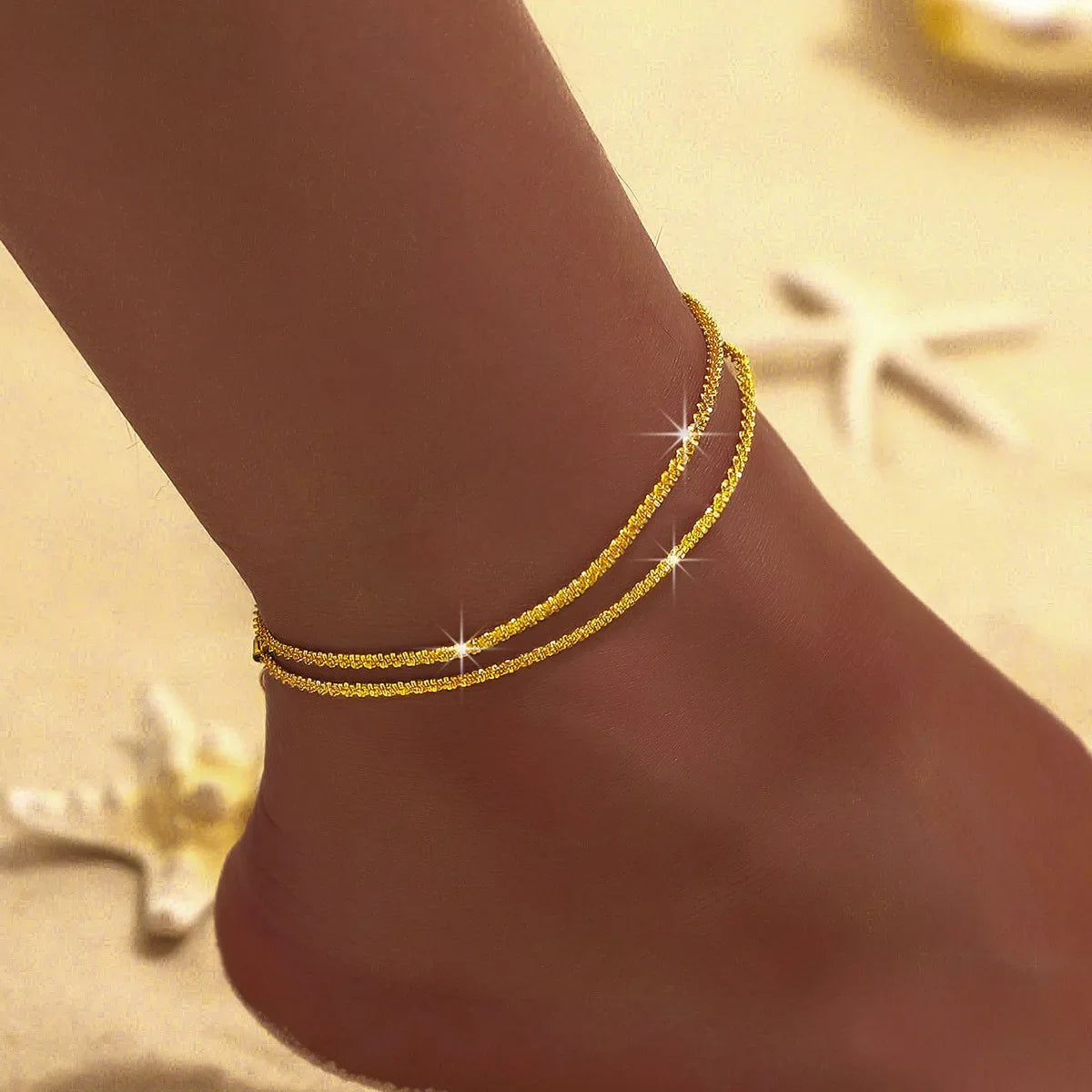
It's the question nobody asks out loud but many type into a search engine: does an ankle bracelet have a sexual meaning? The rumor has been circulating long enough for people to genuinely hesitate about wearing jewelry they like. So it deserves a clear, documented, and straightforward answer: no, there is no sexual code attached to an ankle bracelet. The remaining questions are where this idea comes from, what it truly means, and what this jewelry actually signifies.
If your question is more about the image the jewelry projects in society, that's a related but distinct topic, covered in our article on the vulgar or chic cliché. Here, we are specifically addressing the alleged sexual meaning.
Where the rumor comes from, and why it doesn't die
The idea that an ankle bracelet signals availability, a couple's practice, or a relationship status originated on the internet, on forums, and spread through replication. It does not appear in any ethnographic work, any serious sociological study, or any book on jewelry history. It has no source, no date of origin, and no foundation.
What makes it persistent is its structure: it's an unfalsifiable rumor. It claims to describe a secret code, so the absence of proof becomes proof of its secret nature. This is exactly the mechanism that keeps urban legends alive. Add to that the fact that it concerns jewelry placed on a body part associated with summer nudity, and you have a story that is easy to tell and difficult to verify.
We must also name what it does: it assigns a sexual intention to a woman based solely on an accessory. This is an ordinary mechanism of social control, akin to comments on the length of a skirt. It is not information; it is a judgment disguised as knowledge.
The short answer
An ankle bracelet signals nothing about your intimate life. No code, no convention, no tradition assigns it this role. It is a piece of jewelry, just like a wrist bracelet — whose uses we compare here without anyone ever having attributed a secret code to the latter.
What history actually says about this jewelry
Ankle jewelry is one of the oldest and most geographically widespread forms of adornment. It can be found in ancient Egypt, where it accompanied other adornments and primarily signaled the wearer's rank and wealth. The material and craftsmanship made the social difference, not the act of wearing it.
In India, the tradition of the payal is particularly well-documented. These silver ankle bracelets, often adorned with bells, belong to the realm of weddings, classical dance, and major family occasions. One detail is very telling: they are made of silver and not gold, because gold is associated with the divine and people avoid wearing it below the waist. This is a precise religious and social convention — the exact opposite of a hidden code.
What these traditions have in common is striking: wherever ankle jewelry has carried meaning, that meaning was public, asserted, and often linked to marriage or status. Never clandestine. The modern rumor, therefore, exactly reverses the historical logic of the jewelry. We have traced this long history in our article on its meaning, origin, and styles.

ANKLET — Symbol
Gold Ankle Bracelet with Cross Pendant
€24.90
A symbolic pendant worn on the ankle: the meaning we give to a piece of jewelry comes from what we put into it, not from a code others might have written for you.
Discover →Left or right: the code that isn't one
The most widespread variation of the rumor is that of the left ankle versus the right ankle, each supposedly signaling something different. This is the version that generates the most searches, and it is also the easiest to debunk: the sources that relay it don't even agree among themselves on what each side would mean. When a supposed code changes meaning depending on the page you read, it's not a code.
In practice, the choice of side is dictated by perfectly prosaic reasons. You wear the jewelry on the side opposite your watch for balance, on the side of your dominant leg or the other depending on what causes the least discomfort, on the side where the skin has no scars, or simply on the most comfortable side. Right-handed people tend to put it on the right out of reflex, which explains part of the observed statistics. We detail these concrete criteria in our guide on which ankle to choose.
However, there are real, acknowledged, and documented symbolic meanings carried by patterns and colors rather than by the side. The red thread, for example, refers to a tradition of protection that we discuss in the article dedicated to the red thread, and hues have their own associations, described in our guide to the meaning of colors. These meanings are claimed by those who wear them. That's the whole difference.
Variants of the rumor, and why none hold up
The rumor doesn't circulate in a single form; it has variations. Reviewing the variants is instructive, because they contradict each other — which is the surest sign that none are based on anything.
The oldest version claims that an ankle bracelet signals a specific relationship status within a couple. It has the particularity of being unverifiable by design: no community claims it, no group identifies with it, and the vast majority of people supposedly using this code have never heard of it. A code that only the uninitiated know is not a code.
A second, vaguer version associates the jewelry with a supposed romantic availability. It runs into a simple obstacle: ankle bracelets are widely worn by people in relationships, married, and of all ages. If it signaled availability, it would be false in the majority of observable cases — which disqualifies the hypothesis of a signal.
A third, more recent version tries to link the rumor to an alleged ancient tradition. This one requires the most vigilance because it borrows the vocabulary of history. However, real traditions, both Egyptian and Indian, openly associate ankle jewelry with social status and marriage. Invoking history to support the rumor is precisely invoking what contradicts it.
Finally, there's a last version, purely aesthetic, which is not really the same rumor: the idea that ankle jewelry is "too much." This falls under taste and context, not meaning, and it's a debate we address for its own sake in the article on the vulgar or chic cliché, and then from a generational perspective in our guide to ankle bracelets for all ages.

ANKLET — Elegant
Gold Ankle Chain with Zircon Stone Pendant
€24.90
A delicate gold chain with a pendant, in the most classic style of ankle jewelry: worn for oneself, without wondering how it will be interpreted.
Discover →What about men?
The rumor almost exclusively targets women, which speaks volumes about its nature. When a man wears an ankle bracelet, nobody looks for a hidden code: it's seen as a style accessory, summery or bohemian, and that's that. This asymmetry is another clue that the subject isn't the jewelry, but the way women who wear it are viewed.
In practice, men's ankle bracelets are growing in popularity, in a understated style: braided cords, woven designs, discreet steel chains, worn under trousers or visible in summer. The codes are detailed in our guide to men's ankle bracelets, and the choice of materials in the steel or silver comparison. All models are gathered in the men's collection.
What the ankle bracelet means in France today
In 2026, in France, wearing an ankle bracelet means nothing more than what you want it to mean. It's a fashion accessory, reintroduced through beach and bohemian styles, then integrated into daily life, as we describe in our article on its return to trendiness. It is worn at all ages, in all social circles, and increasingly by men.
The only context where a convention truly exists is that of couple or friendship jewelry, where two people decide together to wear the same piece. There, the meaning is explicit, chosen, and known by both. This is the subject of our article on the duo bracelet. Nothing to do with a signal sent to strangers.
If the fear of others' judgment is what holds you back, the real question is not symbolic but stylistic: a fine, discreet, well-proportioned piece of jewelry provokes no comments anywhere. This is the logic of quiet luxury applied to the ankle, developed in our article on discreet jewelry, and the question of the workplace is treated separately in can one wear it at work.

ANKLET — Minimalist
Minimalist Gold Heart Ankle Bracelet
€24.90
A delicate and understated piece, the format that triggers no particular interpretation: one notices the overall look, not the accessory.
Discover →The real meanings: those we choose
Dismissing a false symbolism does not mean that the ankle bracelet carries no meaning at all. It does, but they work in reverse of the rumor: they are explicit, assumed, and decided by the wearer of the jewelry. They are conveyed through the pattern, material, or color, never by the side or by the simple act of wearing one.
The red thread is probably the best-known case: it refers to a tradition of protection that we detail in the article dedicated to the red thread. In the same vein, symbols of luck—Greek evil eye, Hamsa hand, clover—have a precise history, described in our guide to lucky charms.
Natural stones constitute another language, where each mineral is associated with virtues by lithotherapy: this is the subject of our article on natural stones. Figurative motifs work in the same way, whether it's the heart, a symbol of affection, the cross, the lily, or the starfish.
The difference is fundamental. These symbols are ones you claim: you choose the design because it resonates with you, and you can explain it if asked. The supposed sexual meaning, however, would be attributed to you without your consent and without you being able to dispute it. It's not symbolism; it's a projection.
What to say if someone comments on it
The question isn't just theoretical. Sometimes, someone will make an insinuation, at the office, with family, or in a comment under a photo. Knowing how to respond changes how you wear the jewelry, because you stop anticipating it.
The most effective response is factual and brief: this supposed meaning is an internet myth, with no source, no basis, and no community that claims it. Historically, ankle jewelry signaled social rank in Egypt and marriage in India, always openly. Stated calmly, this ends the conversation, because the person usually has no source to counter with—they are just repeating what they read.
There's a second, even shorter, and often more accurate response: it's jewelry. You don't ask someone what their watch or ring means. The asymmetry of the questioning itself is the best refutation, and pointing that out is usually enough.
If the comment comes from a professional context and makes you uncomfortable, the question becomes practical rather than symbolic: a delicate piece of jewelry worn snugly under pants won't be seen, and the issue no longer arises. Office guidelines are covered in our article on anklets at work, and the most discreet models are in the selection of delicate chains.
Finally, one simple thing must be said: you don't owe anyone an explanation. The rumor works because it puts the wearer in a defensive position. Refusing to engage on those terms is the most direct way to defuse it.
Wearing it without questioning it
The best way to sidestep this debate is to choose a piece of jewelry whose obvious style answers the question before it's even asked. A delicate gold or silver chain, worn snugly, is immediately understood as jewelry and nothing more. This is the realm of anklet chains and the women's collection.
For everyday wear that lasts all year without damage, stainless steel remains the most reliable material, as detailed in our material guide; relevant models are in the stainless steel collection. For a more summery and bohemian vibe, shell models found in the shell collection and woven models from the woven collection fulfill this role perfectly. And for men, everything is in the men's collection.
A final word on size, because it determines comfort and thus whether you'll actually wear it: jewelry of the correct length is forgotten. Measurement guidelines are compiled in our guide for measuring your ankle, and all styles, materials, and uses are gathered in the complete guide to anklets and ankle chains. You can also directly browse all our anklets.


