

Cart
0
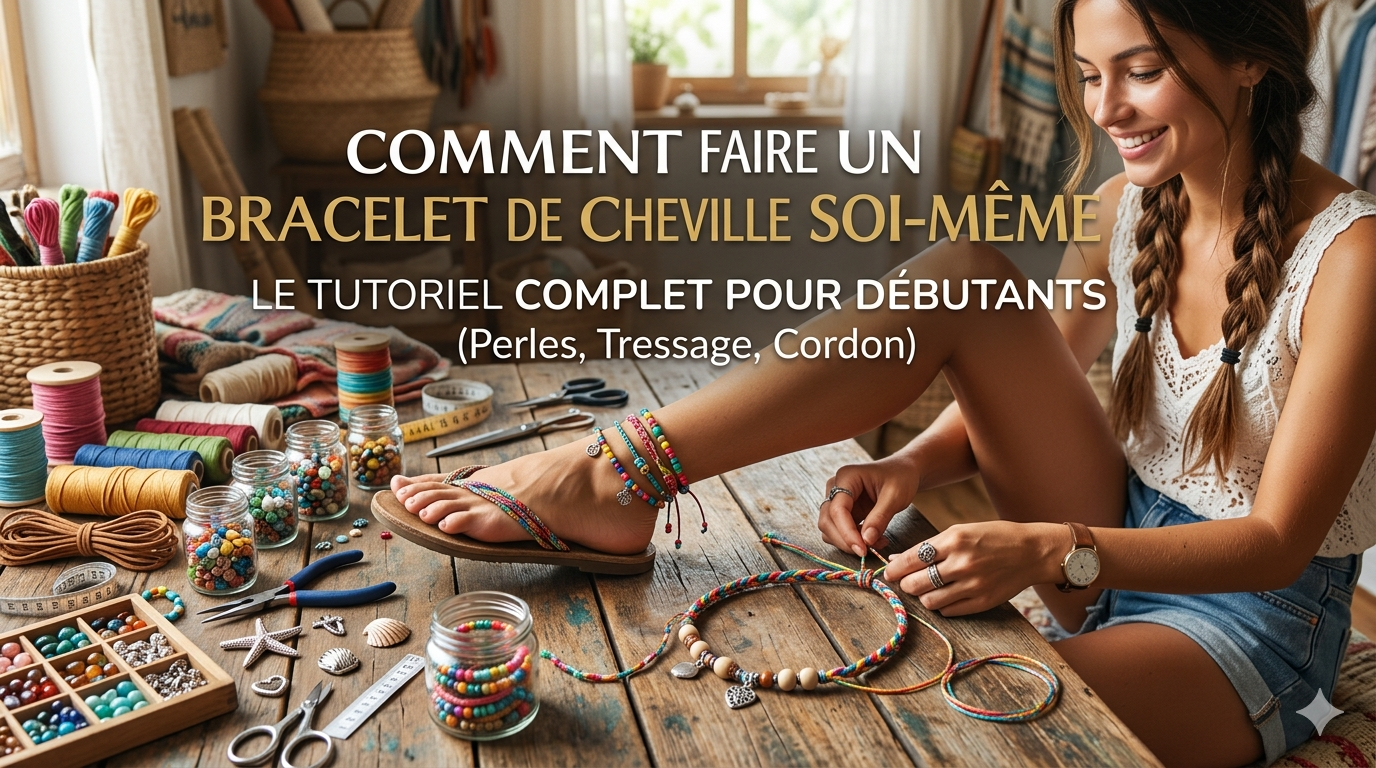
There's something deeply satisfying about wearing a piece of jewelry you've made with your own hands. An ankle bracelet is particularly well-suited for this: minimal materials, simple techniques to learn, and a result that can be adapted to your skin tone, summer wardrobe, and mood of the day. Whether you're looking for a calming manual activity for a rainy Sunday, an idea for a workshop to share with a friend, or simply the desire for a truly unique design, learning to make your own ankle bracelet is more accessible than you might imagine.
This guide will walk you through, step by step, from choosing your supplies to the finishing touches, covering the three main techniques that any beginner can master in an afternoon: beaded strands, braiding, and knotted cords. You'll also find useful tips for measuring your ankle, avoiding common mistakes, and creating a piece of jewelry that lasts, even with your feet in the water.
🧵 Why make your own ankle bracelet
The first reason is obvious: total personalization. When you make your own jewelry, you choose every detail. The color of the thread, the size of the beads, whether or not to include a small seashell, the exact length that fits your anatomy. You are no longer dependent on what's available in stores: you create the piece that precisely matches the image you have in mind. For those who love the bohemian spirit, it's an open door to an infinite number of variations, and our ideas and inspirations for a bohemian ankle bracelet already give a good idea of the possibilities.
The second reason is the pleasure of the craft. Threading beads, tying a knot, watching a pattern take shape between your fingers: these are activities that slow down the pace and soothe the mind. Many people discover beadwork as a true escape, halfway between creative hobby and meditation. An ankle bracelet, being shorter than a necklace and less technical than a ring, is the ideal project to start without getting discouraged.
Finally, there's the sentimental aspect. A handmade bracelet tells a story. Given to a friend, exchanged between sisters, or worn as a souvenir of a specific summer, it becomes an object laden with meaning, far beyond its material value. This is also the same logic behind the success of the personalized ankle bracelet with initial or symbol: the jewelry ceases to be a simple accessory and becomes a small piece of oneself.
Good to know
Before you start, keep in mind that handmade work doesn't have to be perfect. A slight irregularity in bead spacing or a slightly more pronounced knot adds to the charm of a handmade piece. This is precisely what distinguishes your creation from a mass-produced item.
🪡 Materials to gather before you start
Good news: you don't need a full workshop to get started. A few basic supplies are enough, and most can be found in haberdashery stores, craft shops, or even a simple sewing box. The central element remains the base, i.e., what will hold your jewelry. For beads, transparent elastic thread is favored, very practical as it avoids the need for a clasp, or stronger braided nylon thread for chain-style designs. For braiding, waxed cotton thread or embroidery floss is used, sold in skeins of all colors. For more structured versions, a fine cotton or vegan leather cord works wonders.
Next come the decorative elements. Tiny, shiny seed beads give a delicate and luminous finish; wood or stone beads bring a more natural and bohemian touch. One or two small drilled seashells, a miniature starfish, or a gold charm are enough to define your style. If you like the virtues attributed to minerals, you can draw inspiration from our article on the natural stone ankle bracelet to choose beads with meaning.
For hardware, plan for small lobster clasps, jump rings, and, for adjustable designs, a few crimp beads. A pair of fine scissors, flat-nose pliers, and possibly wire cutters complete the kit. The choice of material is never insignificant: it determines the final look, but also its durability. To fully understand the differences between silver, steel, beads, shells, and cord, the complete guide to ankle bracelet materials will save you many disappointments, especially if you have sensitive skin.
One last piece of advice before tying the first knot: think about your skin. Some people tolerate prolonged contact with nickel-containing metals poorly. If this is your case, opt for textile bases or hypoallergenic findings. Our dedicated article, what materials to avoid if you have sensitive skin, details the right steps to take when purchasing supplies.
📏 How to measure and calculate the correct length
This is the step beginners most often overlook, and it's also what separates a comfortable piece of jewelry from a bracelet that slips or pinches. Before cutting any thread, measure your ankle circumference where you will wear the jewelry, usually just above the bone. A dressmaker's tape measure works perfectly; failing that, wrap a piece of string and then transfer the length to a ruler. The complete method, with comfort margins to allow depending on whether you like a snug or loose fit, is explained step by step in our guide on how to measure your ankle without ever getting the size wrong.
The golden rule is to add a margin to the raw measurement. Allow about two centimeters more than your ankle circumference for a comfortable fit, and up to three if you like the slightly floating movement typical of summer styles. If you are attaching a clasp, also account for the length it will take up. And never forget that elastic thread stretches a bit with use: it's better to cut it slightly shorter than a rigid thread. For an adjustable bracelet with a sliding knot, however, generously leave extra thread at the ends, as these will allow for adjustment.
🌿 Three step-by-step techniques for beginners
Time to get practical. The following three methods cover the essentials of what a beginner can achieve at home. Each gives a different style, and nothing prevents you from combining them once you get the hang of it.
Beaded strands on elastic thread
This is the most accessible technique, ideal for a first creation. Cut a length of elastic thread corresponding to your measurement plus about ten centimeters for safety. Thread your beads one by one, composing the pattern as you go: alternating colors, gradient, regular or random rhythm – it's up to you. When the length is right, firmly tie the two ends with a double flat knot, add a drop of jewelry glue to the knot to secure it, then slip the knot inside a neighboring bead to hide it. Cut off any excess, and there you have your first bracelet. If you're unsure about the choice of beads and their combination with a chain or a shell, the article beads, shell or chain, how to choose will help you decide.
Once you've mastered the basic technique, have fun incorporating a small central charm or playing with bead sizes to create texture. The result will be all the more harmonious if you pay attention to spacing. To give you an idea of combinations that work daily, take a look at our tips for wearing a beaded ankle bracelet.

ANKLET — Gold beads
Gold Beaded Ankle Bracelet
€27.90
No time to string your own beads? This ready-made gold design offers the same summery sparkle, with a neat finish and a clasp that lasts all season.
Discover →Braiding and macrame
Braiding creates those bohemian bracelets that we immediately associate with bare feet on the sand. The basic principle is that of a classic three-strand braid, but you can quickly increase the complexity with flat macrame knots. Choose three complementary colored waxed cotton threads, join them with a knot at one end, secure this knot with adhesive tape on a table, then braid regularly until you reach the desired length. Finish with a knot, and leave some thread on each side so you can tie the bracelet directly around your ankle. This endlessly adaptable technique is at the heart of the aesthetic detailed in our bohemian guide to braided ankle bracelets.
Macrame takes this logic further with its flat knots that form raised patterns. It's a bit more technical, but none of the steps are beyond the reach of a patient beginner. The trick is to always work with consistent tension: too loose, the pattern will distort; too tight, the bracelet will become rigid. A few beads slipped in during braiding are enough to embellish the whole piece. If your threads tend to tangle while working, our simple solutions for tangled bracelets apply to both making and wearing them daily.

ANKLET — Woven shells
Woven Ankle Bracelet with Shells
€27.90
Want the macrame look without the hours of knotting? This hand-woven design, punctuated with real shells, captures all the summer spirit of successful homemade craftsmanship.
Discover →Cord and sliding knot
This last technique appeals to those who want an adjustable piece of jewelry without a metal clasp. You start with a thin cord, optionally thread a few central beads onto it, then join the two ends with a sliding knot. The principle is simple: each end wraps around the opposite strand two or three times before being tied, so that the knots can be slid to tighten or loosen the bracelet. This is the ideal solution for gifting, as the recipient can adjust the size themselves. The cord also has the advantage of being soft and light, particularly pleasant in summer. To vary the pleasures, there's nothing to stop you from layering several creations, as we explain in the article on multi-strand ankle bracelets and their styling.
💧 Finishing, clasps, and care
A well-finished bracelet is recognized by three details: an invisible or neat knot, secured ends, and material that withstands your lifestyle. If you've chosen a lobster clasp, attach it with crimp beads and a jump ring, making sure to flatten the bead well with flat-nose pliers. For knotted designs, a drop of transparent jewelry glue ensures nothing will come undone with the first movement. Also, consider very lightly burning the end of a nylon thread, using a lighter held at a distance, to prevent fraying – a gesture reserved for adults and to be done with caution.
Durability then depends on use. A beaded bracelet on elastic thread doesn't like repeated showers or sea salt, while a cord resists water better but can fade in the sun. The general rule is to remove textile creations before swimming and let them dry flat. For jewelry with metal components, a soft cloth is enough to restore their shine. All the right steps are gathered in our guide on how to care for an ankle bracelet and keep it looking new. And if you want to delve deeper into understanding this piece of jewelry, from its history to its styles, the complete guide page on ankle bracelets and ankle chains is a reference to keep handy.
The mistake to avoid
Never tighten a handmade bracelet to the point where it marks the skin. The ankle swells slightly in the heat and at the end of the day. A too-tight piece of jewelry quickly becomes uncomfortable, even irritating. It's better to allow a little play and enjoy the slight sway that gives this jewelry its charm.
🛍️ Make your own or choose a ready-to-wear design
Making your own ankle bracelet is a rewarding adventure, but it takes time, a few materials, and a dose of patience. Not everyone has the desire or availability to dedicate themselves to it, and that's perfectly legitimate. Some pieces, especially those that combine delicate beads, natural shells, and water-resistant finishes, require expertise acquired through experience. For these cases, or simply to complement a homemade creation, it's perfectly reasonable to turn to pre-made models. You can also browse our entire collection of ankle bracelets to find combinations that will inspire your own attempts.
Many amateur designers work this way: they make the simple models they master and buy the more elaborate pieces. If braiding attracts you, the woven ankle bracelets collection offers an excellent repertoire of patterns to reproduce. For bead enthusiasts, the beaded ankle bracelets collection is full of assembly and color ideas. And for a beach vibe, nothing beats a detour to the shell ankle bracelets collection, a goldmine for anyone who wants to incorporate a marine touch into their creations.

ANKLET JEWELRY — Multi-strand beach
Bohemian Multi-Strand Beach Ankle Bracelet
€29.90
The multi-strand inspiration in its most accomplished version: shell, starfish, and pearls brought together for a vacation spirit that lasts all summer.
Discover →Whether it ends up on your ankle or a friend's, your first creation will remain a memory. Start simple, with a row of beads on elastic thread, take the time to measure correctly, and let yourself be carried away by the desire to experiment. Very quickly, you'll have your favorite colors, your preferred knots, and maybe even a small collection to rotate depending on the day. A self-made ankle bracelet has only one rule: it must resemble you. To fuel your inspiration throughout the seasons, keep the ankle bracelets and ankle chains reference page within reach, and have fun.

