

Cart
0
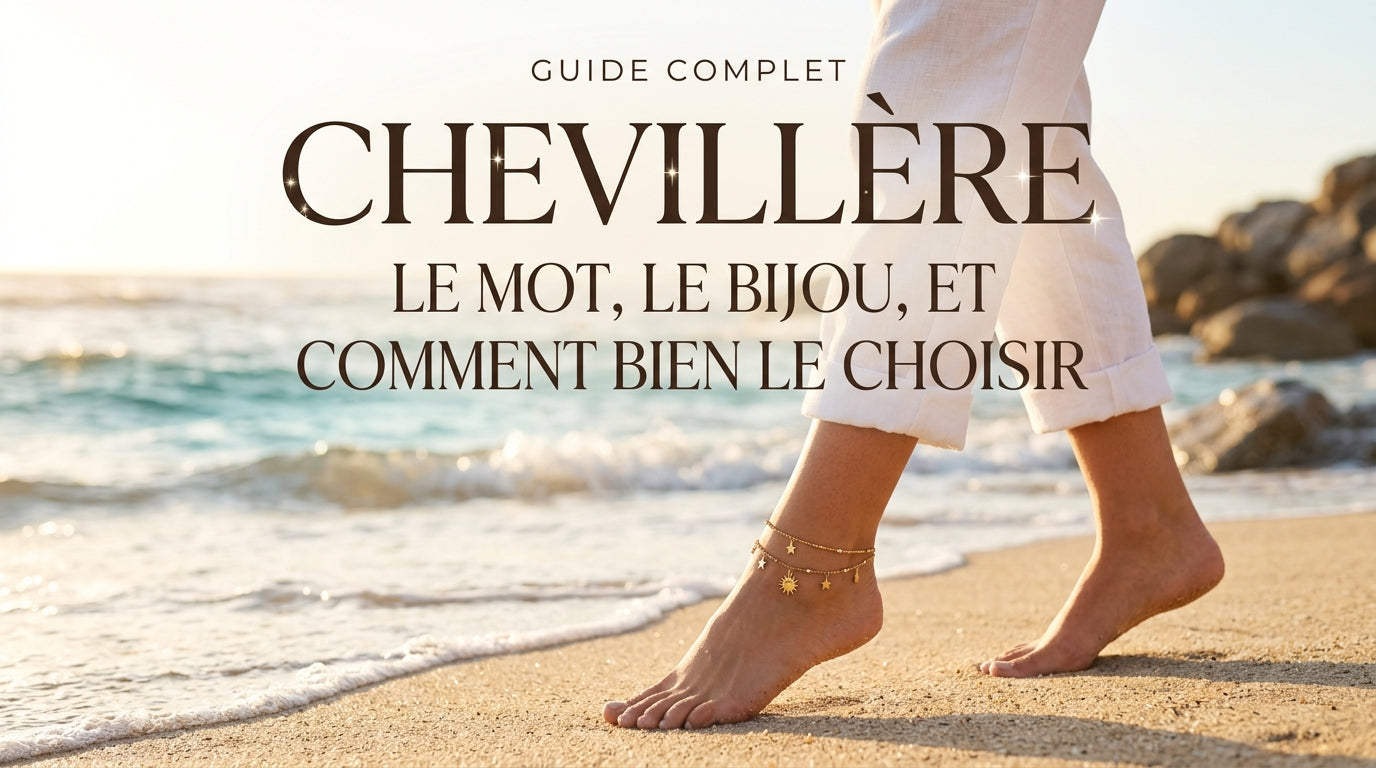
The word "chevillère" (anklet) causes constant confusion. Typed into a search engine, it brings up two entirely unrelated worlds: on one hand, jewelry worn on the ankle; on the other, an elastic support sold in pharmacies. This article clarifies the ambiguity, then focuses on the jewelry: what the term covers, how it differs from other names, and how to choose a model that lasts.
Two objects, one word
In medical and sports vocabulary, a "chevillère" (anklet) refers to an orthosis: an elastic band or splint designed to support the joint after a sprain or during exertion. It is a support device with no decorative purpose, and only a healthcare professional can advise you on it.
In jewelry vocabulary, the same word refers to an ankle jewel. It is less common than "bracelet de cheville" (ankle bracelet) or "chaîne de cheville" (ankle chain), but it circulates, especially in the south of France and among artisanal creators. This article discusses this meaning.
This ambiguity has a practical consequence: if you simply type "chevillère" (anklet) when searching for jewelry, you will get a mix of results. Specify "chevillère bijou" (jewelry anklet) or directly use "bracelet de cheville" (ankle bracelet), which is the most common and precise term in French.
"Chevillère," "bracelet de cheville," "chaîne de cheville": what's the difference?
The three words refer to the same family of objects, but they are not perfectly interchangeable in usage. "Bracelet de cheville" (ankle bracelet) is the generic term: it covers all materials, from braided cord to metal chains, including beads and shells. This is the word to use if you want to be understood unambiguously.
"Chaîne de cheville" (ankle chain) refers more specifically to metal chain models. It is a subset, not a synonym, and the distinction is detailed in our article on the difference between the two. The types of links also have their own vocabulary, reviewed in the chain link guide.
"Chevillère," finally, is mainly used orally and tends towards flexible, wide, or artisanal models—a woven piece, a cord, something a bit more substantial than a delicate chain. This is not a rule, but a usage trend. There is also a fourth, distinct object: the piece of jewelry that connects the ankle to the toes, described in our article on the foot chain.
The simple guideline
If you are buying, use "bracelet de cheville" (ankle bracelet): it's the broadest and most widely understood term. Reserve "chaîne de cheville" (ankle chain) for chain link models, and be aware that "chevillère" also refers to a medical device—this precision avoids misunderstandings.

ANKLE JEWELRY — Gold-plated Steel
Gold-plated Steel Ankle Bracelet for Women
€26.90
A gold-plated steel model, in the most versatile style: subtle enough for everyday wear, bright enough for summer, and water-resistant.
Discover →Why the word exists and why it persists
"Chevillère" is formed in exactly the same way as "jarretière" (garter) or "bracelet" (bracelet): a body part name to which a suffix is added to denote what surrounds it. The construction is perfectly regular in French, and this is precisely why the word spontaneously reappears among people who have never read it: it can be guessed.
Its coexistence with the medical meaning is not exceptional. French is full of words that refer to both a functional object and a decorative object—a "ceinture" (belt) can be a fashion accessory or a lumbar support device, a "minerve" (cervical collar). The context clarifies, and no one is bothered by it. For the "chevillère," the confusion is simply more intense because both objects are worn on the same spot.
What explains the persistence of the word in jewelry vocabulary is that it fills a void. "Bracelet de cheville" (ankle bracelet) is long and redundant orally; "chaîne de cheville" (ankle chain) excludes anything that is not metal. "Chevillère" offers a unique, short word that covers the entire family. This is a real need, which is why the term circulates among creators and at artisan markets much more than in catalogs.
Should it be used? Orally, by all means, if your interlocutors understand it. In writing, and especially when searching for a product, it's better to stick to "bracelet de cheville," which remains the most universally understood term and the one that will bring up relevant results. The complete vocabulary of ankle jewelry, including chain links, is detailed in our guide to chain link types.
The five families of ankle jewelry
Whatever word is used, the offerings fall into five main families, and understanding their real characteristics avoids many disappointments.
Metal chains are the most classic. Thin or thick, gold or silver, they provide a clean look and can be worn all year round. This is also the family most demanding in terms of length, because they don't adapt: an extra centimeter is noticeable. Their weakness is the clasp; their strength, their sobriety and ease of maintenance.
Woven and cord styles form the second family. These are the most size-tolerant, because they often close with a sliding knot, and the most comfortable under a shoe as they have no sharp edges. On the downside, the fiber wears out, discolors in the sun, and stretches with humidity. These are seasonal pieces rather than decade-long investments, and you should buy them knowing this.
Beads constitute the third family. Glass, natural stone, resin, or mother-of-pearl, they add color and volume without metallic thickness. The critical point is not the bead but the thread: elastic stretches out in one summer, a braided or cabled thread lasts for years. This is the most difficult information to obtain before purchasing, and the most important.
Shells and natural materials form the fourth family, inseparable from summer and seaside aesthetics. They do not react with the skin, making them a good choice for sensitive individuals, but they are fragile: a shell crushed in a shoe cannot be repaired. These are jewels to be worn barefoot.
The fifth family includes pendant or charm models, which cut across the other four. This raises a specific question: anything that dangles can get caught. On an ankle, a bulky pendant can get snagged on a pant cuff or a sandal strap. The common-sense rule is to stick to coin-sized or smaller for daily wear, and reserve more expressive models for barefoot occasions.
What makes an anklet last or not last
Regardless of the word used, an ankle jewel is subjected to stresses that a wrist bracelet does not experience: friction from shoes, sand, water, and constant flexing. This explains why so many inexpensive models end up at the bottom of a drawer after one summer. The difference comes down to three points.
The first is the material. Stainless steel and genuine silver resist water and perspiration; low-grade alloys do not. This is the main cause of jewelry that blackens or greenens the skin, a phenomenon explained in our article on verdigris and in the one on blackening. A complete overview of materials can be found in our materials guide.
The second is the clasp, the most stressed part and the first to fail. A good quality spring ring, or a sliding knot on a woven model, holds much better than a thin hook. The third is length: a piece of jewelry that is too long rubs more, gets caught, and wears out faster. The method for finding the right length is in our guide to measuring your ankle, and the tangling problem has its solutions in this dedicated article.
If you have sensitive skin, the question of materials takes precedence over all others: our article on sensitive skin details what to avoid, and the one on nickel allergy goes further on the subject.

ANKLE JEWELRY — Multi-strand
Gold and Black Multi-strand Ankle Chain
€24.90
A multi-strand design that provides presence without bulk: the format that best corresponds to what is orally referred to as an "anklet".
Discover →How to wear it according to morphology and season
An anklet, in the sense of a piece of jewelry that is a bit more substantial than a delicate chain, is not worn the same way depending on the ankle it adorns. On a slender ankle, a wide model can overwhelm the line and give the impression of an ill-fitting bracelet; it's better to opt for delicacy or the layering of two delicate strands. On a more robust ankle, the opposite is true: a too-discreet model disappears and appears too small.
These proportion considerations are detailed in our morphology guide, and the question of metal according to skin tone in the article on metal and skin tone. The general rule remains balance: the jewelry should be noticeable without monopolizing attention.
The season matters just as much. In summer, barefoot, the jewelry is visible along its entire length, and a more assertive model makes perfect sense. In winter, under a sock or in a boot, a wide model rubs, snags, and gets damaged—this reasoning is developed in our article on winter. Many people also keep two distinct pieces of jewelry, one for the warm season and one for everyday wear, a logic explained in our summer vs. daily comparison.
As for layering, it changes everything: two delicate strands often look better than one wide piece and are easier to adjust. The principles are in our stacking guide, and coordinating with other jewelry in the article on jewelry sets.
Which model to choose according to use
For everyday wear, all year round, under closed shoes, aim for sobriety and steel: a thin model, without a prominent pendant, that you can forget you're wearing. Office dress codes are detailed in our article on work, and discreet styles in the one on discreet jewelry.
For summer and bare feet, the field opens up: shells, beads, colorful cords. Marine models are gathered in the shell collection and flexible models in the woven collection. Pairings with sandals are detailed in our dedicated article, and beach models in our beach selection.
For an occasion, the criterion becomes delicacy: a delicate chain worn snugly complements a dress without ever overpowering it, as explained in our guide to wearing an ankle bracelet with a dress. Feminine models are collected in the women's collection, beaded models in the bead collection, and masculine models in the men's collection.

ANKLET — Occasion
Fringed Rhinestone Elegant Ankle Bracelet
€24.90
A luminous piece for summer evenings and special occasions: the format you bring out when the jewelry needs to be seen, without ever becoming cumbersome.
Discover →Summary
“Anklet” refers to both an ankle jewel and a medical support device: always specify the context. For a jewel, the clearest term remains “ankle bracelet”, and “ankle chain” when it is a link model. What determines the lifespan of the jewel is not the word but the material, the clasp, and the length. All styles and uses are covered in the complete guide to ankle bracelets and ankle chains, and the entire catalog in all our ankle bracelets.
If you only remember one thing, let it be this: vocabulary has no bearing on the quality of what you buy. A seller who talks about an “anklet” sells neither better nor worse than a seller who talks about an “ankle bracelet”. What distinguishes a good purchase from a bad one comes down to three concrete pieces of information: the precisely named material, the type of closure, and the actual length in centimeters. A product sheet that provides these three elements allows you to decide; a sheet that avoids them asks you to trust.
This requirement is all the more justified for an ankle jewel as the area is particularly harsh: humidity, rubbing in the shoe, bumps against door frames, sand in summer. A jewel that would hold up without problem on the wrist might not survive a season on the ankle. This is the real reason why it’s worth asking these questions before buying rather than after.
And if you like the word, keep it. “Anklet” is pretty, it’s correctly formed, and it refers to something that French didn’t have a good name for. The only reflex to keep is to specify “jewelry” when the context can be confusing — whether in a pharmacy or in a search engine.
One last practical remark for those buying online: if a site uses “anklet” without ever specifying what it’s talking about, be wary. Serious sellers name their product with the clearest possible term, because they want to be found by the right buyers. Vague vocabulary is rarely a sign of a precise catalog, and this applies to material descriptions as much as to the name of the jewel.

