

Cart
0
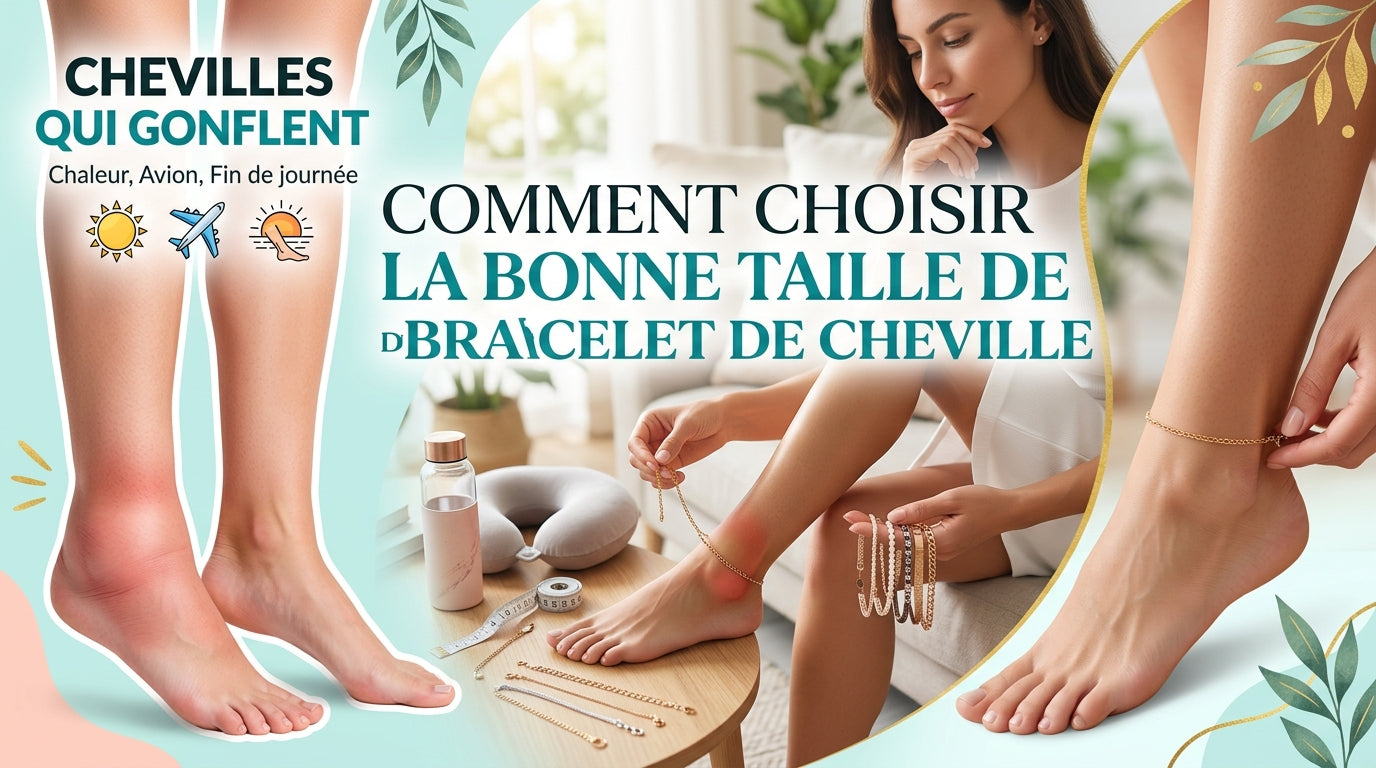
You bought an ankle bracelet that fit perfectly. You put it on one July morning, it barely slid over your ankle bone. In the evening, when you returned home, it was digging into your skin and you had to remove it. You haven't gained weight, nor has your jewelry shrunk: your ankle's circumference changed between breakfast and the evening news. This is common, physiological, and yet it is the primary reason why ankle jewelry is abandoned—far more so than style or metal quality.
🌡️ Why Ankles Swell—and Why Jewelry Notices Before You Do
The ankle is the lowest point of the body when you are standing. Everything your venous and lymphatic system needs to return to the heart starts there, working against gravity. As soon as this return flow slows down—due to heat, prolonged immobility, standing, or end-of-day fatigue—a small amount of fluid remains in the tissues instead of flowing back. This is not fat, it's not weight gain: it's water, and it settles exactly where your jewelry rests.
The extent of this phenomenon is often surprising. On an ordinary summer day, ankle circumference can vary by five to ten millimeters between waking up and going to bed. This is imperceptible to the naked eye. But an ankle bracelet that is precisely fitted translates these ten millimeters into a very concrete sensation: the jewelry that rotated freely in the morning becomes a ring that presses against the skin. This is why many people believe they chose the wrong size, when they simply measured at the wrong time. The measurement method itself is not the issue—we detail it in our complete guide to measuring your ankle—it's the timing of the measurement that changes everything.
The Four Most Common Triggers
Heat comes first. When the temperature rises, blood vessels dilate to release heat, and venous return becomes less efficient. This is why the problem intensifies in July and August, precisely when ankle jewelry is worn the most. The ankle bracelet season is also the swelling season—an irony no product description ever mentions.
Immobility follows, and it is more insidious. Sitting at a desk for eight hours with bent legs can cause as much swelling as a three-hour walk. The calf muscles no longer contract, and they are essential for pumping blood. A long car journey, a four-hour flight, or a day-long train ride produce the same effect, often more pronounced because legroom is restricted.
Prolonged standing affects all professions where people do not sit down: retail, catering, hairdressing, care, teaching. Swelling at the end of a shift is real and repetitive. If you wear jewelry at work, this factor outweighs style—a topic we cover from a different angle in the article on ankle bracelets at the office.
Finally, diet and hormonal cycle explain day-to-day variations with no apparent cause. A very salty meal, excessive alcohol consumption, or certain phases of the menstrual cycle promote water retention. This is what gives the impression that the same piece of jewelry "no longer fits the same" from one week to the next.
What is not ankle swelling
If the skin reddens, itches, or forms small vesicles under the jewelry only, it is not water retention but a skin reaction. The symptoms, the metals involved, and what to do are detailed in our article on nickel allergy, and more broadly in the guide sensitive skin and materials to avoid. Swelling, on the other hand, is symmetrical, painless, and affects the entire ankle—not just the contact band.
Finally, there are types of swelling that fall outside the scope of this article. An ankle that swells on only one side, that remains indented for a long time when pressed, or that is accompanied by pain or local heat requires medical attention, not a jewelry choice. This text discusses ordinary swelling, that which occurs due to heat and long days, which ninety percent of people experience without paying attention.

MOST FORGIVING — WOVEN SLIDING KNOT
Woven Ankle Bracelet with Shells
€27.90
The textile thread follows the ankle instead of constricting it, and the sliding knot can be loosened with a simple gesture at the end of the day. This is the model you wear from morning to night without thinking about it, even in the middle of a heatwave.
Discover →📐 Measuring a Moving Ankle: The Double Measurement Method
Most sizing guides tell you to wrap a measuring tape around your ankle and note the number. This is correct but incomplete: a single number doesn't describe a joint that varies. What you need is not a measurement, but a range.
Take Two Measurements, Twelve Hours Apart
Take a first measurement in the morning, within an hour of waking up, before you've walked for a long time. This is your minimum. Take the second measurement at the end of the day, ideally after a normal day of activity, without having elevated your legs. This is your maximum. Do this on a hot day if you can: you will get the real amplitude, not an optimistic version.
You will then get two numbers, for example, 23.2 cm and 24.1 cm. The difference—here nine millimeters—is your swelling amplitude. It is this, and not your average ankle circumference, that should dictate the type of jewelry you buy. An amplitude of less than five millimeters gives you complete freedom: you can wear fixed jewelry. Beyond one centimeter, an adjustment system is no longer a comfort, it's a condition for wearing.
The Comfort Margin, in Numbers
To your evening measurement—the largest one—add between one and two centimeters. One centimeter for a delicate chain that you want close to the bone, two for a model you prefer to see resting on your foot. This margin is not an approximation: it's what separates a piece of jewelry that slides comfortably from one that leaves an imprint. For an ankle that swells a lot, aim for the higher end of the range. A slightly loose bracelet in the morning remains wearable; a snug bracelet in the morning becomes unbearable in the evening.
The direction of the error therefore matters greatly. Too large can be corrected—we explain how to shorten a too-large bracelet yourself without returning it. Too small, however, can almost never be corrected on a finished piece of jewelry. When in doubt between two sizes, always take the larger one.
The Finger Test, to be Done in the Evening
Once the jewelry is in place, slip a finger between the bracelet and your skin at the end of the day. If your finger passes easily and the jewelry can turn a quarter of the way around your ankle, the size is good. If your finger has difficulty entering, it's too tight for summer. If two fingers pass, the jewelry might slide down to your foot and snag—a common issue with multi-strand models that we discuss in the guide on combining multi-strand models.
Key numerical reference
Evening measurement + 1 to 2 cm = your size. Amplitude < 5 mm: fixed jewelry possible. Amplitude 5 mm to 1 cm: adjustment desirable. Amplitude > 1 cm: adjustment essential. When in doubt between two sizes, always choose the larger one. The full details of reference sizes are in the ultimate ankle bracelet guide.
⚙️ Adjustment Systems, Ranked by Tolerated Amplitude
Not all ankle jewelry adjusts in the same way. Here are the four main families, from most tolerant to most rigid, with what each truly handles.
The Sliding Knot: Maximum Amplitude
This is the most generous system. Two cord strands are tied around each other, and the knots are slid to open or close the jewelry. The useful amplitude easily reaches three to four centimeters, well beyond any ordinary swelling. Adjustment can be done with one hand, without looking, which is crucial when you want to discreetly loosen it during a meeting or on a plane. Its other asset is the flexibility of the material: a textile cord slightly deforms with the ankle instead of opposing it with a rigid ring.
It is mainly found on woven and bohemian models. If this style appeals to you, articles on the braided ankle bracelet and on bohemian inspiration detail the variations, and the entire selection is grouped in the woven ankle bracelets collection.
The Extension Chain: Adjustment by Notches
On a chain, the lobster clasp attaches to a small chain extended by two to five centimeters. Each link is a notch. This is the most common system in metal jewelry, and it perfectly accommodates daily swelling: you wear it on the third link in the morning, on the fifth in the evening, without disassembling anything.
Its limitation is visual. The dangling extension chain hangs behind the ankle and is visible, especially on a delicate and shiny model. Some people are fine with this, others are not. The classic solution is to choose a chain whose links are substantial enough for the extension to blend into the design—the differences between links are explained in our comparison of link types, and the question of fineness in the chain thickness guide.

NOTCH ADJUSTMENT — CHAIN
Gold-Plated Ankle Chain with Shiny Links
€34.90
Its intricate link design visually absorbs the extension chain: you can change notches throughout the day without it being noticeable. The elegance of a gold chain, the flexibility of jewelry that adapts to your ankle.
Discover →Elastic: Practical, but with a Caveat
Beaded bracelets mounted on elastic thread slip over the foot and simply stretch as the ankle swells. On paper, it's the ideal solution. In practice, there are two caveats. First: elastic that is constantly stretched will loosen, and jewelry that has spent a summer stretching every evening will eventually no longer stay on. Second: elastic applies constant and uniform pressure, which becomes uncomfortable precisely on the day you swell the most.
It remains an excellent choice for seasonal or occasional use—holidays, beach, festivals—and it dominates the category of beaded models. Tips for choosing them are in our guide to beaded ankle bracelets, and lighter plant-based materials are covered in the article on coconut beads.
Fixed Jewelry: When it's Still Playable
A soldered chain, a rigid bangle, or a so-called permanent piece of jewelry offers no adjustment. This is not prohibitive, with one condition: that the size was chosen based on the evening measurement, with a two-centimeter margin. A correctly sized fixed piece of jewelry will float in the morning and rest comfortably in the evening. If poorly sized, it becomes a daily problem that no adjustment will solve. This is the only case where the double measurement is not a comfort but an absolute necessity—the topic is further developed in the article on stainless steel and seawater.
☀️ Situations That Cause Swelling, One by One
Summer and Heatwaves
This is the most common and most underestimated scenario. You buy a piece of jewelry in spring, it fits perfectly; the first heatwave makes it uncomfortable. The useful tip is simple: any anklet purchased for summer should be sized based on a measurement taken in warm weather. If you measure in March to wear in August, systematically add half a centimeter to your margin. Models designed for the season are gathered in our article on anklets for the beach, and the question of daily wear versus summer wear is compared in summer versus daily anklets.
Air travel and long journeys
Flying is the worst-case scenario: pressurized cabin, dry air, immobility, bent legs. On a long-haul flight, swelling often exceeds one centimeter and takes several hours to subside after landing. The rule is to loosen it before takeoff, not during the flight—once swollen, a clasp becomes much harder to handle. A model with a sliding knot can be adjusted while seated, without bending over, which is not insignificant in an airplane seat. Other travel precautions are gathered in the guide anklets for travel.
Standing all day, and sitting all day
Both cause swelling, for opposite reasons. When standing, hydrostatic pressure accumulates; when sitting, the calf muscle pump no longer functions. In both cases, the peak is between 5 PM and 8 PM. If you choose a piece of jewelry that you will mostly wear at work, measure yourself at the end of a real workday, not on a Sunday. The style adapted to the professional context is discussed separately in our article anklets and work.
Pregnancy
Pregnancy swelling follows a different logic: it is gradual, sets in over several weeks, and can significantly exceed the usual daily amplitude. What is needed is not an adjustment, but an evolving size—thus, in practice, a cord model or a chain with a generous extension. We dedicate an entire article to this situation, with preferred models and those to avoid: anklets and pregnancy.
Sport and recovery
During exertion, the ankle swells little—the muscle pump is working at full capacity. It is after that the volume increases, at the end of a run or an intense session. Jewelry worn during training should therefore be sized for after, not during. Compatibility and precautions are detailed in anklets and sport.

MULTIPLE SIZES — WATERPROOF STEEL
Heart Stainless Steel Anklet – Waterproof
29,90 €
Available in several lengths so you can choose based on your evening measurement, and impervious to water and sweat. The one you don't take off at the pool, in the shower, or during hot weather.
Discover →🧵 Materials that forgive, and those that punish
For the same size, two pieces of jewelry behave differently on a swelling ankle. The material and construction change everything, and this is a criterion almost never mentioned at the time of purchase.
Cord and textile thread are the most forgiving. They deform, flatten slightly under pressure, and don't create sharp edges. A slightly tight cord remains bearable where a chain of the same diameter would become painful. The downside is well-known: they wear out, discolor, and don't tolerate chlorinated water well.
Flexible chain links—curb, rolo, figaro—come in second. They conform to the ankle's shape and distribute pressure evenly around the circumference. These are the best chains for an ankle that fluctuates in size. Conversely, rigid or wide links, tight Milanese mesh, and bangles concentrate pressure on specific points and become uncomfortable as soon as the volume increases.
The metal itself matters less than one might think for comfort, but a lot for what happens when the skin swells and sweats more. A swollen ankle is a warm and moist ankle: this is exactly the context where a mediocre alloy leaves a mark. This phenomenon is explained in detail in the article on green marks and in the one on skin blackening. If you know you swell and sweat in summer, opt for stainless steel, titanium or 925 silver rather than entry-level plating. A general comparison of materials can be found in our materials guide, and the associated budget question in the article on anklet prices.
Weight, this forgotten parameter
On a swollen ankle, a heavy piece of jewelry sits lower and rubs more. A lightweight model—textile thread, plant beads, fine steel or titanium chain—is forgotten where a massive piece of jewelry reminds you of its presence every ten minutes. If you are hesitating between two equivalent models, choose the lighter one: it is the best comfort compromise available, and it costs nothing. The minimalist spirit, developed in our article on minimalist anklets, here aligns with pure ergonomic common sense.

THE LIGHTEST — MINIMALIST STEEL
Minimalist Steel Anklet with Pearl Pendant
34,90 €
A fine chain that weighs almost nothing and doesn't mark the skin, even at the end of a summer day. The discreet piece of jewelry you put on in May and still find on your ankle in September.
Discover →💎 Choosing jewelry that lives with your ankle
Let's summarize the logic, because it's quite simple. Measure twice, morning and evening, on a hot day. Keep the evening measurement and add one to two centimeters. Then look at the difference between your two readings: that's what determines the adjustment system you need. Below five millimeters, anything goes. Between five millimeters and one centimeter, an extension chain is sufficient. Beyond that, use a cord with a sliding knot and stop thinking about it.
The rest—style, metal, length, symbolism—can then be chosen freely. This is precisely the benefit of settling the size question first: once it's resolved, you can buy on impulse without risking it ending up in a drawer. If you're starting from scratch, the complete guide to anklets and ankle chains covers the whole topic, and the article how to choose an anklet according to your lifestyle combines size with other criteria. The seven checks to make before buying are listed in this article.
Regarding selection, there are three entry points depending on what you're looking for. For a piece of jewelry that can handle fluctuation without compromise, check out the woven cord models. For an extension chain that stays beautiful and adjusts effortlessly, ankle chains cover all styles. For a metal that won't react to heat or sweat, the stainless steel collection is the safe choice. And if you simply prefer to browse everything, it's all gathered in our complete anklet catalog, also available for women and men.
One last remark, which applies to everyone. An anklet is not supposed to be felt. If it reminds you of its existence at seven in the evening, it's neither a flaw of the jewelry nor a flaw of your body: it's a sizing problem, and it can be resolved with two measurements and a margin. This is probably the simplest and most cost-effective correction you can make to how you wear this piece of jewelry—even more so than choosing the right charm or color that suits you. And if yours is already there, a little too snug, the article on anklet care will help you keep it impeccable until you replace it with the right one.

